The 2025 State of Data Strategy & Governance: Key Metrics, Trends & GE Case Study
By Carsten Krause, February 15, 2025
Introduction: The Data Explosion and Governance Imperative For Your Organization
The digital economy runs on data. Organizations are generating and consuming more data than ever before, but many fail to treat it as a strategic business asset. Instead, businesses are drowning in redundant, obsolete, and trivial (ROT) data, struggling with trustworthiness issues, and missing opportunities to monetize proprietary data.
A 2023 Veritas Technologies study found that 85% of enterprise data is ROT or “dark data”, meaning that it is either redundant, obsolete, or unclassified. This data glut is not just an operational burden but a financial and security risk, costing enterprises an estimated $3.3 trillion annually in wasted storage costs, compliance fines, and cybersecurity threats (https://www.scc.com/partner-newsfeed/vendor/veritas-releases-global-databerg-report/).
Compounding these challenges is Shadow IT—the unsanctioned use of software and storage outside of IT’s control—which now accounts for 62% of enterprise security incidents (https://www.mckinsey.com/business-functions/mckinsey-digital/our-insights/shadow-it-the-business-risk-you-dont-see). Unstructured data, which accounts for 80% of all enterprise data, remains largely unmanaged and untapped (https://www.idc.com/getdoc.jsp?containerId=prUS48221621).
The time for reactive data management is over. Companies must implement proactive governance, AI-driven automation, and data monetization strategies to turn their data liabilities into assets.
This article explores six key data strategy and governance metrics:
Unstructured Data Management Efficiency – The ability to classify, structure, and leverage unstructured data.
- ROT Data Reduction Rate – How effectively enterprises eliminate redundant and obsolete data.
- Data Trustworthiness Index – The ability to ensure accuracy, security, and unbiased data.
- Enterprise Data Monetization Rate – Measuring success in generating revenue from proprietary data.
- Shadow IT Data Exposure Rate – Assessing risks of unsanctioned data storage and software.
- Data Observability Score – How well companies track and diagnose real-time data pipeline issues.
1. ROT Data Reduction Rate: Streamlining Data Assets
The accumulation of redundant, obsolete, and trivial (ROT) data not only inflates storage costs but also hampers operational efficiency and escalates security risks. Effectively managing and reducing ROT data is essential for organizations striving to optimize their data ecosystems.
A 2016 Veritas Global Databerg Report revealed that 33% of stored data is ROT, contributing significantly to unnecessary storage expenses. This statistic highlights the financial and operational burdens posed by unmanaged data proliferation.
ROT data is more than just wasted storage—it creates:
- Security risks: 43% of all data breaches involve redundant or old data left unprotected.
- Compliance failures: GDPR, CCPA, and other regulations penalize companies that fail to properly manage personal data.
- Operational inefficiencies: Employees waste 30% of their workweek searching for accurate information within bloated systems (https://www.scc.com/partner-newsfeed/vendor/veritas-releases-global-databerg-report/).
Estimated ROT Cost Savings based on industry averages
| Company | Industry | Estimated Total Data (PB) | Estimated ROT Data (PB) | Potential Annual Cost Savings ($M) |
|---|---|---|---|---|
| Vertex Pharmaceuticals | Biotechnology | 3 | 0.99 | 3.366 |
| Hewlett Packard Enterprise | Technology | 8 | 2.64 | 8.976 |
| Staples | Retail | 4 | 1.32 | 4.488 |
| Martin’s Point Health Care | Healthcare | 2 | 0.66 | 2.244 |
| Schneider Electric | Energy Management | 6 | 1.98 | 6.732 |
| FM Global | Insurance | 5 | 1.65 | 5.61 |
| Ocean Spray | Food & Beverage | 2 | 0.66 | 2.244 |
Note: These figures are hypothetical and for illustrative purposes only.
Best Practices for ROT Reduction:
- AI-Powered Data Classification: Machine learning algorithms automatically tag, categorize, and delete ROT data.
- Automated Retention & Deletion Policies: Enterprises must set automated lifecycles for data storage, ensuring compliance.
- Centralized Data Governance: A unified governance framework ensures consistent ROT data policies across all departments.
To combat this, organizations are increasingly adopting AI-driven data classification tools that automate the identification and elimination of ROT data. Such technologies not only reduce storage costs but also enhance data quality, ensuring that valuable insights are derived from reliable and relevant data sources.
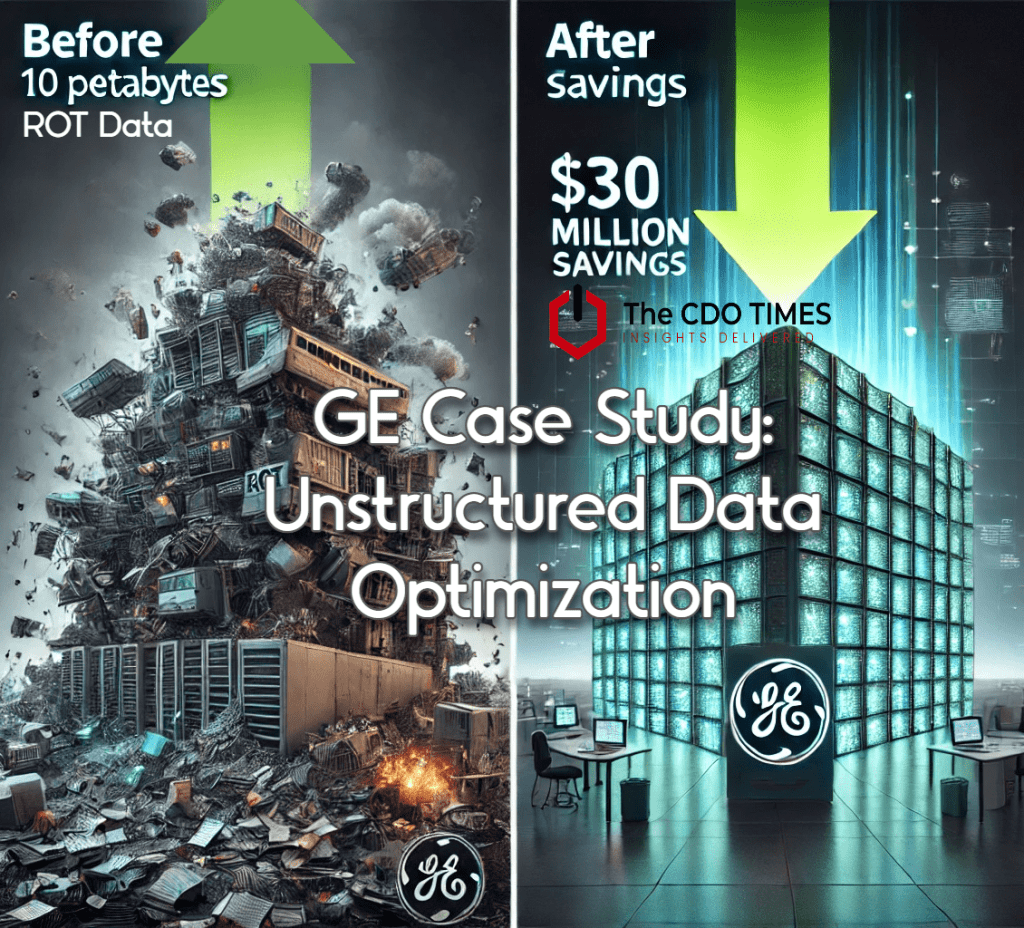
Case Study GE and Zantaz Data Resources:
This collaboration with Zantaz (https://www.zantazdataresources.com/) AI Data Detect has significantly reduced GE’s data storage costs and enhanced the effectiveness of its analytics programs.
GE’s big data problems:
- ROT Data: Duplicate shared data that had not been cleaned up
- Dramatic data storage cost increase every year with about 10 petabytes of data
- Complex data management issues due to recent split into 3 companies
Ge has been in the process of a large data migration and during the early analysis with Zantaz they realized that 50% of their data has not been accessed for over 5 to 10 years.
ROI: substantial cost savings and improved data analysis:
By scanning and enriching the data classifications Zantaz Ai Data Detect, Ge was able to intelligently re-tier its data storage resulting in:
- Deletion about 25% of the data
- Moved 25% of the data to cheaper storage
- Moved over 4 PB of data off of expensive Tier 2 storage
- Moved nearly 6 PB of previously unidentified unactionable, dark data to significantly cheaper cloud-based storage.
- Achieve savings in an estimated $30M
- Reduced 60% in storage costs over 3 years.
2. Data Trustworthiness Index: Ensuring Data Integrity
In an era where data-driven decision-making is integral to business success, the trustworthiness of data becomes a critical focal point. Ensuring data accuracy, security, and the mitigation of biases is essential for maintaining stakeholder confidence and achieving reliable outcomes.
A high Data Trustworthiness Index reflects an organization’s dedication to upholding stringent data quality standards. This involves implementing robust validation processes, securing data against unauthorized access, and actively identifying and addressing biases in data collection and analysis.
Inaccurate, biased, or unverified data leads to poor AI models, regulatory failures, and bad business decisions. 67% of executives report poor data quality has led to incorrect insights that negatively impacted business performance (https://www.precisely.com/resource-center/analystreports/2023-data-integrity-trends-and-insights).
Key Strategies to Improve Data Trustworthiness:
- Automated Data Lineage Tracking: Full transparency on where data originates and how it is used.
- Real-Time Validation & Monitoring: AI-powered anomaly detection to flag inaccurate data before it affects decisions.
- Bias Detection in AI Models: Governance frameworks to ensure AI models are trained on fair and unbiased data.
For instance, Syngenta, a global agriculture company, enhanced its data trustworthiness by publishing open data, demonstrating a commitment to transparency and reliability. This initiative not only built trust with stakeholders but also promoted collaborative research, leading to innovations in the agriculture sector.
3. Enterprise Data Monetization Rate: Capitalizing on Data Assets
Transforming data into a revenue-generating asset has become a strategic priority for forward-thinking organizations. A higher Enterprise Data Monetization Rate indicates successful strategies in leveraging data for financial gain, thereby contributing to the organization’s profitability.
Data is no longer just an IT asset—it’s a product. Companies successfully monetizing data generate five times more revenue than those that do not.

How to Monetize Enterprise Data:
- Data Licensing & Partnerships – Selling insights to partners and industry players.
- Subscription-Based AI & Analytics – Providing premium, AI-driven data insights as a service.
- Internal Monetization – Using data insights to optimize internal operations and cut costs.
Such success stories underscore the potential of data monetization when effectively executed.
projected growth of the global data monetization market:
| Source | Market Size (2023) | Projected Market Size | CAGR | Forecast Period |
|---|---|---|---|---|
| Grand View Research | $3.24 billion | $16.05 billion by 2030 | 25.8% | 2024–2030 |
| Fortune Business Insights | $2.99 billion | $12.62 billion by 2032 | 17.5% | 2024–2032 |
| MarketsandMarkets | $2.9 billion (2022) | $7.3 billion by 2027 | 19.5% | 2022–2027 |
| Data Bridge Market Research | $3.24 billion | $15.84 billion by 2031 | 21.95% | 2024–2031 |
| Mordor Intelligence | $5.00 billion (2025) | $12.41 billion by 2030 | 19.94% | 2025–2030 |
Source: https://www.fortunebusinessinsights.com/data-monetization-market-106480
To emulate this success, companies must treat data as a strategic asset, investing in data commercialization strategies such as licensing, offering analytics-driven insights, and developing AI-powered services. This approach not only unlocks new revenue streams but also enhances competitive advantage in the marketplace.
4. Shadow IT Data Exposure Rate: Mitigating Unauthorized Risks
Shadow IT refers to the use of unauthorized software, devices, or cloud applications within an enterprise without IT department approval. This practice introduces significant challenges, including data breaches, compliance violations, and financial losses, as it circumvents established security protocols and data governance policies.
62% of cyber incidents stem from Shadow IT, where employees store data in unsanctioned locations like Google Drive and Dropbox (https://www.mckinsey.com/business-functions/mckinsey-digital/our-insights/shadow-it-the-business-risk-you-dont-see).
Steps to Reduce Shadow IT Risks:
- Cloud Security Posture Management (CSPM) to detect unauthorized cloud activity.
- Zero-Trust Security Frameworks to restrict access to critical data.
- Employee Training & Policies to prevent unauthorized data storage.
To mitigate these risks, enterprises must deploy continuous monitoring tools, enforce strict policy adherence, and adopt zero-trust security frameworks. These measures are essential to detect and address unauthorized IT usage, ensuring that all technology aligns with the organization’s security and governance standards.
5. Data Observability Score: Enhancing Pipeline Visibility
As organizations scale their AI and analytics capabilities, maintaining robust data observability becomes crucial. A high Data Observability Score reflects an organization’s proficiency in monitoring and maintaining the health of its data infrastructure, ensuring the reliability of data-driven applications.
For example, Uber faced challenges with faulty data pipelines, leading to inaccurate fare calculations. By implementing machine learning-driven data observability solutions, Uber reduced data outages by 92% and improved pricing accuracy, thereby enhancing user trust and operational efficiency.
To achieve similar outcomes, organizations should invest in real-time monitoring platforms that proactively diagnose and address data pipeline issues, ensuring seamless and reliable data flow across systems.
6. Unstructured Data Management Efficiency
Unstructured data—such as emails, PDFs, videos, and IoT logs—constitutes a significant portion of enterprise data, yet most organizations fail to extract its full value. According to IDC, unstructured data will account for 80% of the data collected globally by 2025. This statistic underscores the urgency for businesses to develop robust strategies for managing and leveraging unstructured data.
The lack of visibility into unstructured data results in regulatory compliance risks, inefficiencies in search and retrieval, and higher storage costs. Traditional relational databases and structured data tools are often inadequate for managing such data types effectively. Companies that have embraced AI-driven data classification and knowledge graphs have begun to unlock the hidden potential within their unstructured data repositories.
Only 29% of companies have real-time data observability—leading to AI model failures, broken analytics, and inaccurate forecasting (https://www.datarobot.com/blog/data-observability-importance-in-ai-ops/).
Companies like Uber implemented real-time observability, reducing data outages by 92% (https://eng.uber.com/data-observability/).
Companies looking to improve their Unstructured Data Management Efficiency should focus on:
- Deploying AI-powered search and classification tools to organize vast amounts of unstructured data.
- Enhancing data lifecycle management to reduce ROT and minimize unnecessary storage costs.
- Improving data governance frameworks to ensure unstructured data meets compliance requirements.
E
CDO TIMES Bottom Line
Data is the single most valuable asset for digital-first enterprises. However, without structured governance and strategic oversight, it quickly becomes a liability. The findings from this article highlight a fundamental shift in data management practices:
- ROT data is eroding enterprise efficiency: Organizations must adopt AI-driven data classification and deletion policies to reduce unnecessary data storage costs.
- Data trustworthiness remains a major issue: Companies must focus on real-time validation, security, and governance to ensure their data is accurate, bias-free, and compliant.
- Data monetization is an untapped revenue stream: Enterprises that successfully monetize their data generate five times more revenue than those that do not.
- Shadow IT continues to expose security vulnerabilities: Strict policy enforcement and zero-trust security models are required to combat unauthorized data usage.
- Data observability is essential for AI-driven organizations: Real-time monitoring and automated anomaly detection will define the future of data pipeline management.
- Unstructured data is still a wild frontier: Companies must leverage AI-powered classification and automation to harness the untapped potential of their unstructured data.
Key Takeaways for Business and Technology Leaders
- Invest in AI-driven data governance tools to automate classification, ROT data reduction, and observability. AI-powered data lifecycle management will enable organizations to proactively manage data sprawl and optimize resources.
- Prioritize compliance and security by enforcing strict governance frameworks that prevent unauthorized data access, reduce Shadow IT risks, and strengthen data observability. The rise of global privacy laws such as GDPR, CCPA, and China’s PIPL make regulatory compliance a top priority for enterprises operating in multiple jurisdictions.
- Leverage data as a revenue-generating asset by treating proprietary data as a monetizable product. Companies should explore new revenue streams through subscription-based analytics, AI-driven insights, and data licensing opportunities.
- Enhance unstructured data management by deploying AI-powered classification tools to extract insights from unstructured data sources such as emails, IoT sensor logs, and customer interactions. Organizations that fail to organize and analyze unstructured data risk falling behind competitors with superior data strategies.
- Prepare for the future of AI-driven decision-making by building an infrastructure that supports real-time analytics, automated data management, and AI-enhanced business intelligence. Data observability will become an essential component in ensuring the accuracy and integrity of AI models that drive enterprise decision-making.
Why Data Governance is a Business Imperative, Not Just an IT Concern
Historically, data governance was often relegated to IT departments, viewed as a backend function focused on data security, storage, and compliance. However, as enterprises evolve into data-driven organizations, data governance is now a core business strategy that impacts revenue, customer experience, risk management, and innovation.
Companies that lack structured governance struggle with operational inefficiencies, compliance risks, and missed revenue opportunities. Without a clear data strategy, organizations face the following consequences:
- Data silos lead to inconsistent decision-making – Poor data integration across departments results in duplicate, conflicting, or inaccessible data. This causes delays, misinformed decisions, and reduced agility in responding to market changes.
- Regulatory non-compliance leads to legal and financial penalties – Data protection laws are becoming stricter worldwide, with significant fines for violations. Poor governance can expose enterprises to lawsuits, brand damage, and loss of consumer trust.
- Poor data quality undermines AI and analytics initiatives – AI models are only as good as the data they are trained on. Organizations with poor data observability struggle with model drift, unreliable predictions, and biased outcomes.
- High storage costs eat into operational budgets – Enterprises that fail to manage ROT data incur excessive storage costs while reducing their ability to extract value from useful data.
- Lack of data monetization strategies results in lost revenue – Organizations that fail to capitalize on data insights for new products, customer experiences, or market intelligence are missing opportunities for growth and competitive advantage.
The future of enterprise success will be determined by how well organizations manage, govern, and monetize their data.
A Call to Action for Executives and Data Leaders
The key to thriving in the digital economy is building a culture of data governance and accountability across the entire organization. This requires a shift from reactive data management to a proactive, strategic approach where governance becomes embedded in every business process.
Executives, CIOs, and CDOs must take ownership of data strategy and governance initiatives by:
- Aligning data governance with business objectives – Ensuring that governance strategies support revenue growth, innovation, and operational efficiency.
- Implementing cross-functional collaboration – Encouraging IT, compliance, marketing, finance, and product teams to work together to maintain data integrity and security.
- Investing in AI and automation – Leveraging cutting-edge data management tools that reduce manual intervention and enhance decision-making capabilities.
- Measuring and optimizing governance performance – Tracking key data governance metrics, including ROT data reduction, data trustworthiness, and monetization rates, to assess ongoing effectiveness.
Companies that succeed in establishing a data-driven culture will gain a significant competitive advantage in an AI-powered business world.
For exclusive research, case studies, and executive insights, join the CDO TIMES Pro Membership:
https://www.cdotimes.com/sign-up/
Love this article? Embrace the full potential and become an esteemed full access member, experiencing the exhilaration of unlimited access to captivating articles, exclusive non-public content, empowering hands-on guides, and transformative training material. Unleash your true potential today!
Order the AI + HI = ECI book by Carsten Krause today! at cdotimes.com/book

Subscribe on LinkedIn: Digital Insider
Become a paid subscriber for unlimited access, exclusive course content, no ads: CDO TIMES
Do You Need Help?
Consider bringing on a fractional CIO, CISO, CDO or CAIO from CDO TIMES Leadership as a Business Consulting Service. The expertise of CDO TIMES becomes indispensable for organizations striving to stay ahead in the digital transformation journey. Here are some compelling reasons to engage their experts:
- Deep Expertise: CDO TIMES has a team of experts with deep expertise in the field of Cybersecurity, Digital, Data and AI and its integration into business processes. This knowledge ensures that your organization can leverage digital and AI in the most optimal and innovative ways.
- Training, developing, arranging, and conducting educational conferences and programs and providing courses of instruction.
- Strategic Insight: Not only can the CDO TIMES team help develop a Digital & AI strategy, but they can also provide insights into how this strategy fits into your overall business model and objectives. They understand that every business is unique, and so should be its Digital & AI strategy.
- Future-Proofing: With CDO TIMES, organizations can ensure they are future-proofed against rapid technological changes. Our experts stay abreast of the latest AI, Data and digital advancements and can guide your organization to adapt and evolve as the technology does.
- Risk Management: Implementing a Digital & AI strategy is not without its risks. The CDO TIMES can help identify potential pitfalls and develop mitigation strategies, helping you avoid costly mistakes and ensuring a smooth transition with fractional CISO services.
- Competitive Advantage: Finally, by hiring CDO TIMES experts, you are investing in a competitive advantage. Their expertise can help you speed up your innovation processes, bring products to market faster, and stay ahead of your competitors.
By employing the expertise of CDO TIMES, organizations can navigate the complexities of digital innovation with greater confidence and foresight, setting themselves up for success in the rapidly evolving digital economy. The future is digital, and with CDO TIMES, you’ll be well-equipped to lead in this new frontier.
Do you need help with your digital transformation initiatives? We provide fractional CAIO, CDO, CISO and CIO services, do a Preliminary ECI and Tech Navigator Assessment and we will help you drive results and deliver winning digital and AI strategies for you!
Subscribe now for free and never miss out on digital insights delivered right to your inbox!