Claude AI: Unboxing Anthropic’s LLM-based AI Assistant, Artifacts & Use Cases – KDnuggets
Dive into this emerging and powerful LLM-based AI tool for enhancing your business, creative, or daily processes through well-managed conversations.

Image by Editor | Ideogram
Claude AI (or simply Claude) is a revolutionary AI assistant, developed by Anthropic. It has gained popularity in the last few months upon the release of its latest version, providing advanced and attractive AI capabilities worth diving into. This article introduces Claude and its most notable features, placing the focus on discussing two key elements:
Upon registering in Claude, the system introduces itself as “a next-generation AI assistant built for work and trained to be safe, accurate, and secure.” This first contact makes clear the tool’s emphasis on placing ethics and safety at center stage, being part of its value proposition against its competitors.
As of the time of writing, the default version of Claude, launched in June 2024, is Claude 3.5 Sonnet, which is a balanced combination between their most efficient and lightweight model, Haiku, and the most powerful one, Opus. Besides having both a free and paid tier, Sonnet can be used in the iOS Claude App and is integrated into Amazon’s AWS Bedrock as well as Google’s GCP Vertex AI. The free version of Sonnet differs from the paid version in the maximum number of chat messages allowed per fraction of a day.
Claude 3.5 Sonnet and its “sibling” models | Image source: claude.ai
Some of the most salient capabilities of Claude AI concerning other LLM-based conversational AI tools, include:
Artifacts are created by Claude, not by us as users. Here’s how it works: if a user requests Claude the creation of standalone content beyond just responses in the conversation — such as code snippets, a full document, or visual content — the generated content pops out in a separate area from the main conversation window. Thus, that self-contained content becomes a reusable artifact. The decision to turn a response into an artifact lies in Claude, depending on the content requested and the conversation context.
One major purpose of artifacts, therefore, is to easily view, edit, or reuse pieces of generated content for modifying them anytime, using them as analysis assets, and so on. But the story does not end there: artifacts are intended to boost collaborative workflows around a centralized resource space. This collaboration premise is one of Anthropic’s future missions, as stated on their site.
Let’s see an example conversation for a marketing-branding use case where a visual artifact is built:
Creating a visual logo design with Claude AI
This example conversation prompts for a logo design based on text specifications. Claude not only generates the visual in scalable vector graphics (SVG) format along with its associated code: but it goes two steps beyond, by automatically turning the generated content into an artifact -placed on the right-hand side window- and providing plenty of detail about the created logo in the main conversational flow -place on the left-hand side window.
Let’s see what happens if we ask for a slightly more ambitious refinement of the logo. Here is the new prompt:
Could we refine the created “gakudō” icon by adding some color to it?
For instance, wooden-like color or textures in the background, as well as turning the curved arrow into a zigzagging path from bottom to top?
And the result becomes a new, separate artifact.
Refined visual artifact
Whilst beautiful and simplistic, at this point it is worth setting realistic expectations and being aware of the capabilities and limitations of the AI behind Claude. This is primarily an LLM-based solution, hence it specializes in generating language-based content: not exclusively natural language, but also code, as illustrated in the above SVG generation example. This means it may not be effective in showing complex visual patterns like “wooden textures”, as asked in the last prompt. The capabilities and limitations of the generated SVG code itself are what set the capabilities and limitations of Claude to address our request. This said, nice logo, anyway!
We finalize by illustrating a few business-oriented use cases where the different capabilities of Claude AI can be leveraged:
A KPI dashboard as a Claude artifact
The associated React code of a KPI dashboard generated as an artifact
Claude AI is being positioned as a flexible and promising conversational AI solution for supporting a wide range of applications and problem-solving scenarios. With a strong emphasis on safety and ethics, its innovative artifacts that help manage generated content effectively, and capabilities like advanced analytical reasoning, Claude could become the next addition to your fleet of AI tools if you give it a try.
Iván Palomares Carrascosa is a leader, writer, speaker, and adviser in AI, machine learning, deep learning & LLMs. He trains and guides others in harnessing AI in the real world.
Get the FREE ebook ‘The Great Big Natural Language Processing Primer’ and ‘The Complete Collection of Data Science Cheat Sheets’ along with the leading newsletter on Data Science, Machine Learning, AI & Analytics straight to your inbox.
By subscribing you accept KDnuggets Privacy Policy
Get the FREE ebook ‘The Great Big Natural Language Processing Primer’ and ‘The Complete Collection of Data Science Cheat Sheets’ along with the leading newsletter on Data Science, Machine Learning, AI & Analytics straight to your inbox.
By subscribing you accept KDnuggets Privacy Policy
Get the FREE ebook ‘The Great Big Natural Language Processing Primer’ and ‘The Complete Collection of Data Science Cheat Sheets’ along with the leading newsletter on Data Science, Machine Learning, AI & Analytics straight to your inbox.
By subscribing you accept KDnuggets Privacy Policy
Get the FREE ebook ‘The Great Big Natural Language Processing Primer’ and ‘The Complete Collection of Data Science Cheat Sheets’ along with the leading newsletter on Data Science, Machine Learning, AI & Analytics straight to your inbox.
By subscribing you accept KDnuggets Privacy Policy
No, thanks!
source
This article was autogenerated from a news feed from CDO TIMES selected high quality news and research sources. There was no editorial review conducted beyond that by CDO TIMES staff. Need help with any of the topics in our articles? Schedule your free CDO TIMES Tech Navigator call today to stay ahead of the curve and gain insider advantages to propel your business!

Image by Editor | Ideogram
Claude AI (or simply Claude) is a revolutionary AI assistant, developed by Anthropic. It has gained popularity in the last few months upon the release of its latest version, providing advanced and attractive AI capabilities worth diving into. This article introduces Claude and its most notable features, placing the focus on discussing two key elements:
Upon registering in Claude, the system introduces itself as “a next-generation AI assistant built for work and trained to be safe, accurate, and secure.” This first contact makes clear the tool’s emphasis on placing ethics and safety at center stage, being part of its value proposition against its competitors.
As of the time of writing, the default version of Claude, launched in June 2024, is Claude 3.5 Sonnet, which is a balanced combination between their most efficient and lightweight model, Haiku, and the most powerful one, Opus. Besides having both a free and paid tier, Sonnet can be used in the iOS Claude App and is integrated into Amazon’s AWS Bedrock as well as Google’s GCP Vertex AI. The free version of Sonnet differs from the paid version in the maximum number of chat messages allowed per fraction of a day.

Claude 3.5 Sonnet and its “sibling” models | Image source: claude.ai
Some of the most salient capabilities of Claude AI concerning other LLM-based conversational AI tools, include:
Artifacts are created by Claude, not by us as users. Here’s how it works: if a user requests Claude the creation of standalone content beyond just responses in the conversation — such as code snippets, a full document, or visual content — the generated content pops out in a separate area from the main conversation window. Thus, that self-contained content becomes a reusable artifact. The decision to turn a response into an artifact lies in Claude, depending on the content requested and the conversation context.
One major purpose of artifacts, therefore, is to easily view, edit, or reuse pieces of generated content for modifying them anytime, using them as analysis assets, and so on. But the story does not end there: artifacts are intended to boost collaborative workflows around a centralized resource space. This collaboration premise is one of Anthropic’s future missions, as stated on their site.
Let’s see an example conversation for a marketing-branding use case where a visual artifact is built:
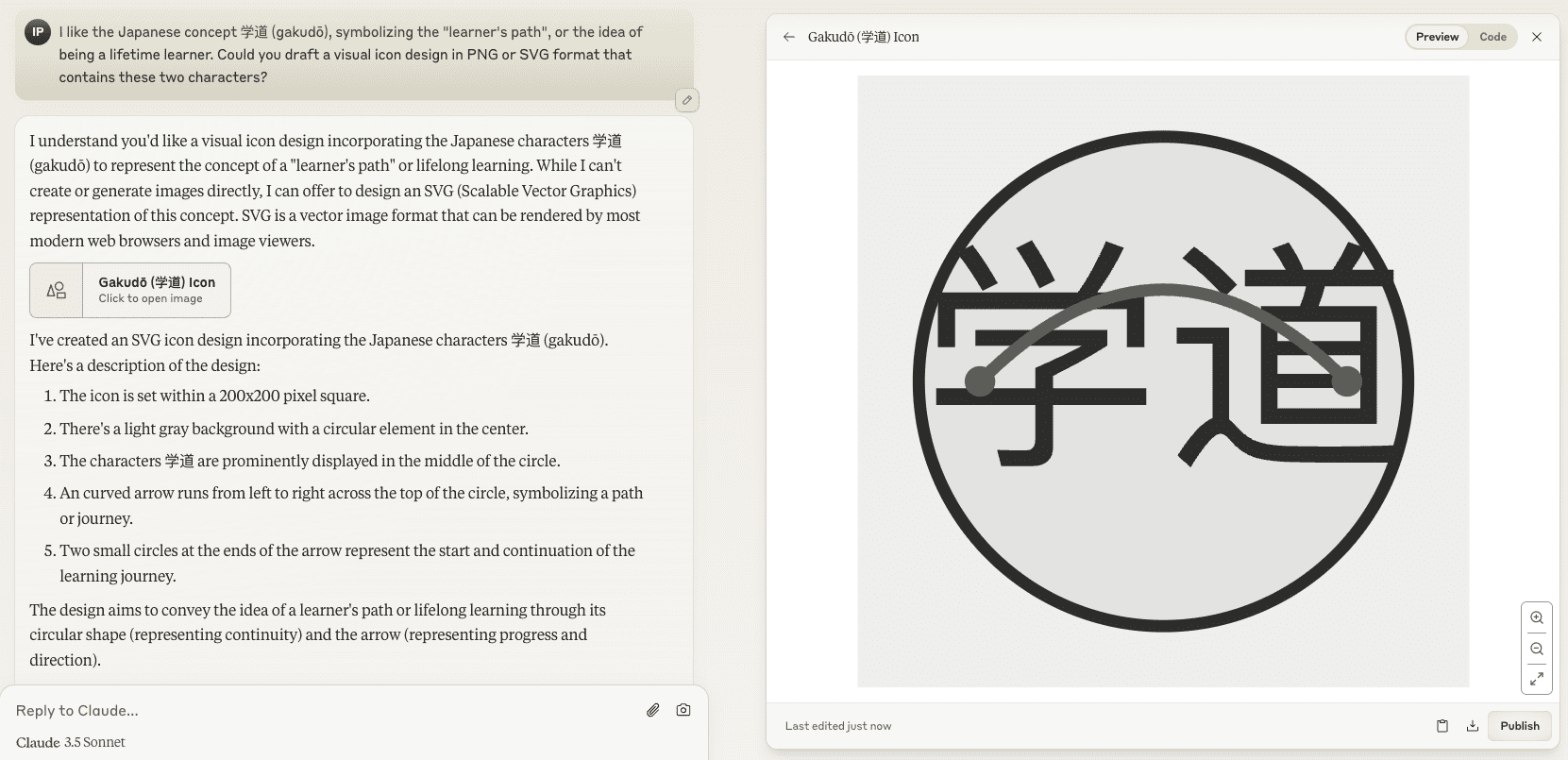
Creating a visual logo design with Claude AI
This example conversation prompts for a logo design based on text specifications. Claude not only generates the visual in scalable vector graphics (SVG) format along with its associated code: but it goes two steps beyond, by automatically turning the generated content into an artifact -placed on the right-hand side window- and providing plenty of detail about the created logo in the main conversational flow -place on the left-hand side window.
Let’s see what happens if we ask for a slightly more ambitious refinement of the logo. Here is the new prompt:
Could we refine the created “gakudō” icon by adding some color to it?
For instance, wooden-like color or textures in the background, as well as turning the curved arrow into a zigzagging path from bottom to top?
And the result becomes a new, separate artifact.
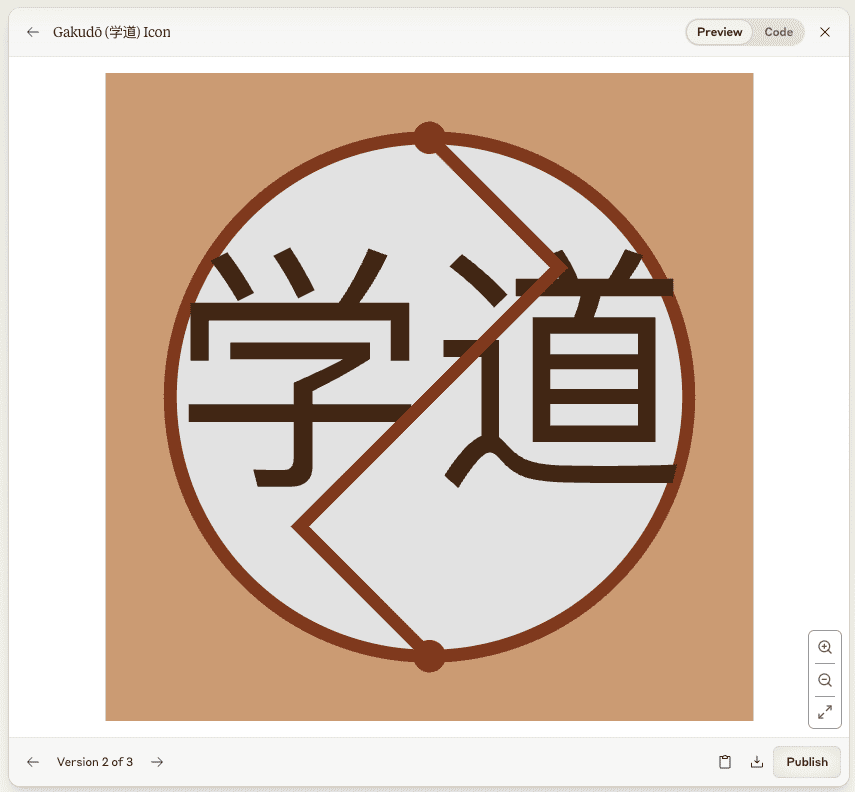
Refined visual artifact
Whilst beautiful and simplistic, at this point it is worth setting realistic expectations and being aware of the capabilities and limitations of the AI behind Claude. This is primarily an LLM-based solution, hence it specializes in generating language-based content: not exclusively natural language, but also code, as illustrated in the above SVG generation example. This means it may not be effective in showing complex visual patterns like “wooden textures”, as asked in the last prompt. The capabilities and limitations of the generated SVG code itself are what set the capabilities and limitations of Claude to address our request. This said, nice logo, anyway!
We finalize by illustrating a few business-oriented use cases where the different capabilities of Claude AI can be leveraged:

A KPI dashboard as a Claude artifact

The associated React code of a KPI dashboard generated as an artifact
Claude AI is being positioned as a flexible and promising conversational AI solution for supporting a wide range of applications and problem-solving scenarios. With a strong emphasis on safety and ethics, its innovative artifacts that help manage generated content effectively, and capabilities like advanced analytical reasoning, Claude could become the next addition to your fleet of AI tools if you give it a try.
Iván Palomares Carrascosa is a leader, writer, speaker, and adviser in AI, machine learning, deep learning & LLMs. He trains and guides others in harnessing AI in the real world.
By subscribing you accept KDnuggets Privacy Policy
Get the FREE ebook ‘The Great Big Natural Language Processing Primer’ and ‘The Complete Collection of Data Science Cheat Sheets’ along with the leading newsletter on Data Science, Machine Learning, AI & Analytics straight to your inbox.
By subscribing you accept KDnuggets Privacy Policy
Get the FREE ebook ‘The Great Big Natural Language Processing Primer’ and ‘The Complete Collection of Data Science Cheat Sheets’ along with the leading newsletter on Data Science, Machine Learning, AI & Analytics straight to your inbox.
By subscribing you accept KDnuggets Privacy Policy
Get the FREE ebook ‘The Great Big Natural Language Processing Primer’ and ‘The Complete Collection of Data Science Cheat Sheets’ along with the leading newsletter on Data Science, Machine Learning, AI & Analytics straight to your inbox.
By subscribing you accept KDnuggets Privacy Policy
No, thanks!
source
This article was autogenerated from a news feed from CDO TIMES selected high quality news and research sources. There was no editorial review conducted beyond that by CDO TIMES staff. Need help with any of the topics in our articles? Schedule your free CDO TIMES Tech Navigator call today to stay ahead of the curve and gain insider advantages to propel your business!