Using 'time travel' to think about technology from the perspective of future generations – Tech Xplore
Click here to sign in with or
Forget Password?
Learn more
share this!
14
Twit
Share
Email
March 19, 2024
This article has been reviewed according to Science X’s editorial process and policies. Editors have highlighted the following attributes while ensuring the content’s credibility:
fact-checked
trusted source
proofread
by Osaka University
The world approaches an environmental tipping point, and our decisions now regarding energy, resources, and the environment will have profound consequences for the future. Despite this, most sustainable thought tends to be limited to the viewpoint of current generations.
In a study published in Technological Forecasting and Social Change, researchers from Osaka University have revealed that adopting the perspective of “imaginary future generations” (IFGs) can yield fascinating insights into long-term social and technological trends.
The researchers organized a series of four workshops at Osaka University, with participants drawn from the faculty and student body of the Graduate School of Engineering. The workshops discussed the state of future society and manufacturing in general, and also looked at one technology in particular: hydrothermally produced porous glass.
During the workshops, the participants were asked to think about this technology from the perspective of IFGs, to imagine how this technology might be adopted in the future and to assess its future potentiality.
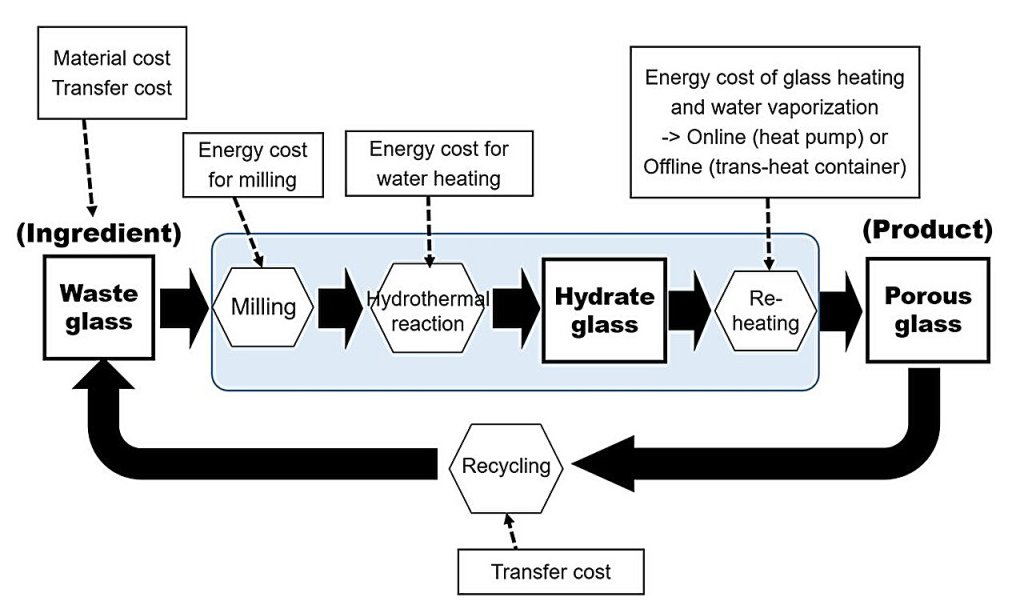
“We chose hydrothermally produced porous glass for the case study because of the generational trade-offs involved,” says lead author of the study Keishiro Hara. “Porous glass is incredibly useful as either a filter for removing impurities or an insulator for buildings. Also, it can be recycled into new porous glass more or less indefinitely.
“The problem is that making it takes a lot of energy—both to pulverize waste glass and to heat water to very high temperatures. There’s a striking trade-off between costs now and gains in the future.”
In the workshops, the participants first looked at issues involving society and manufacturing from the perspective of the present and were then asked to imagine themselves in the shoes of their counterparts in 2040.
“The future the participants imagined was quite different from the future as seen from the perspective of the current generation,” explains Toshihiro Tanaka, senior author. “Most groups described a future in which sustainability has become a central concern for society. Meanwhile, advances in renewal energy mean that energy is abundant, as are resources, as frontiers such as the moon and deep ocean are opened to exploration.
“In this context, hydrothermally produced porous glass comes into its own as a sustainable way to recycle glass, and the energy needed to produce it is readily available.”
The participants were surveyed between workshops and asked to rank indicators related to the future potentiality of the technology. Interestingly, these rankings looked quite different after the workshops in which the participants were asked to take on the perspective of “imaginary future generations.”
“We noticed that when the ‘imaginary future generations’ method, which has been proven to be effective in facilitating long-term thinking, was adopted, participants perceived the feasibility of this technology differently, and their adoption scenarios changed accordingly,” says Hara.
The study suggests that the simple act of putting ourselves in the position of future generations may provide new perspectives on issues of sustainability and technology, helping us to rethink our priorities and set new directions for research and development.
More information: Keishiro Hara et al, Assessing future potentiality of technologies from the perspective of “imaginary future generations” – A case study of hydrothermal technology, Technological Forecasting and Social Change (2024). DOI: 10.1016/j.techfore.2024.123289
Explore further
Facebook
Twitter
Email
Feedback to editors
19 hours ago
0
23 hours ago
0
Mar 18, 2024
0
Mar 18, 2024
0
Mar 16, 2024
0
9 minutes ago
5 hours ago
12 hours ago
13 hours ago
16 hours ago
18 hours ago
18 hours ago
19 hours ago
19 hours ago
20 hours ago
Mar 14, 2024
Mar 18, 2024
Nov 21, 2023
Feb 14, 2024
Mar 7, 2024
Mar 17, 2023
12 hours ago
23 hours ago
16 hours ago
19 hours ago
20 hours ago
18 hours ago
Use this form if you have come across a typo, inaccuracy or would like to send an edit request for the content on this page. For general inquiries, please use our contact form. For general feedback, use the public comments section below (please adhere to guidelines).
Please select the most appropriate category to facilitate processing of your request
Thank you for taking time to provide your feedback to the editors.
Your feedback is important to us. However, we do not guarantee individual replies due to the high volume of messages.
Your email address is used only to let the recipient know who sent the email. Neither your address nor the recipient’s address will be used for any other purpose. The information you enter will appear in your e-mail message and is not retained by Tech Xplore in any form.
Daily science news on research developments and the latest scientific innovations
Medical research advances and health news
The most comprehensive sci-tech news coverage on the web
This site uses cookies to assist with navigation, analyse your use of our services, collect data for ads personalisation and provide content from third parties. By using our site, you acknowledge that you have read and understand our Privacy Policy and Terms of Use.
This article was autogenerated from a news feed from CDO TIMES selected high quality news and research sources. There was no editorial review conducted beyond that by CDO TIMES staff. Need help with any of the topics in our articles? Schedule your free CDO TIMES Tech Navigator call today to stay ahead of the curve and gain insider advantages to propel your business!
Forget Password?
Learn more
share this!
14
Twit
Share
March 19, 2024
This article has been reviewed according to Science X’s editorial process and policies. Editors have highlighted the following attributes while ensuring the content’s credibility:
fact-checked
trusted source
proofread
by Osaka University
The world approaches an environmental tipping point, and our decisions now regarding energy, resources, and the environment will have profound consequences for the future. Despite this, most sustainable thought tends to be limited to the viewpoint of current generations.
In a study published in Technological Forecasting and Social Change, researchers from Osaka University have revealed that adopting the perspective of “imaginary future generations” (IFGs) can yield fascinating insights into long-term social and technological trends.
The researchers organized a series of four workshops at Osaka University, with participants drawn from the faculty and student body of the Graduate School of Engineering. The workshops discussed the state of future society and manufacturing in general, and also looked at one technology in particular: hydrothermally produced porous glass.
During the workshops, the participants were asked to think about this technology from the perspective of IFGs, to imagine how this technology might be adopted in the future and to assess its future potentiality.
“We chose hydrothermally produced porous glass for the case study because of the generational trade-offs involved,” says lead author of the study Keishiro Hara. “Porous glass is incredibly useful as either a filter for removing impurities or an insulator for buildings. Also, it can be recycled into new porous glass more or less indefinitely.
“The problem is that making it takes a lot of energy—both to pulverize waste glass and to heat water to very high temperatures. There’s a striking trade-off between costs now and gains in the future.”
In the workshops, the participants first looked at issues involving society and manufacturing from the perspective of the present and were then asked to imagine themselves in the shoes of their counterparts in 2040.
“The future the participants imagined was quite different from the future as seen from the perspective of the current generation,” explains Toshihiro Tanaka, senior author. “Most groups described a future in which sustainability has become a central concern for society. Meanwhile, advances in renewal energy mean that energy is abundant, as are resources, as frontiers such as the moon and deep ocean are opened to exploration.
“In this context, hydrothermally produced porous glass comes into its own as a sustainable way to recycle glass, and the energy needed to produce it is readily available.”
The participants were surveyed between workshops and asked to rank indicators related to the future potentiality of the technology. Interestingly, these rankings looked quite different after the workshops in which the participants were asked to take on the perspective of “imaginary future generations.”
“We noticed that when the ‘imaginary future generations’ method, which has been proven to be effective in facilitating long-term thinking, was adopted, participants perceived the feasibility of this technology differently, and their adoption scenarios changed accordingly,” says Hara.
The study suggests that the simple act of putting ourselves in the position of future generations may provide new perspectives on issues of sustainability and technology, helping us to rethink our priorities and set new directions for research and development.
More information: Keishiro Hara et al, Assessing future potentiality of technologies from the perspective of “imaginary future generations” – A case study of hydrothermal technology, Technological Forecasting and Social Change (2024). DOI: 10.1016/j.techfore.2024.123289
Explore further
Feedback to editors
19 hours ago
0
23 hours ago
0
Mar 18, 2024
0
Mar 18, 2024
0
Mar 16, 2024
0
9 minutes ago
5 hours ago
12 hours ago
13 hours ago
16 hours ago
18 hours ago
18 hours ago
19 hours ago
19 hours ago
20 hours ago
Mar 14, 2024
Mar 18, 2024
Nov 21, 2023
Feb 14, 2024
Mar 7, 2024
Mar 17, 2023
12 hours ago
23 hours ago
16 hours ago
19 hours ago
20 hours ago
18 hours ago
Use this form if you have come across a typo, inaccuracy or would like to send an edit request for the content on this page. For general inquiries, please use our contact form. For general feedback, use the public comments section below (please adhere to guidelines).
Please select the most appropriate category to facilitate processing of your request
Thank you for taking time to provide your feedback to the editors.
Your feedback is important to us. However, we do not guarantee individual replies due to the high volume of messages.
Your email address is used only to let the recipient know who sent the email. Neither your address nor the recipient’s address will be used for any other purpose. The information you enter will appear in your e-mail message and is not retained by Tech Xplore in any form.
Daily science news on research developments and the latest scientific innovations
Medical research advances and health news
The most comprehensive sci-tech news coverage on the web
This site uses cookies to assist with navigation, analyse your use of our services, collect data for ads personalisation and provide content from third parties. By using our site, you acknowledge that you have read and understand our Privacy Policy and Terms of Use.
This article was autogenerated from a news feed from CDO TIMES selected high quality news and research sources. There was no editorial review conducted beyond that by CDO TIMES staff. Need help with any of the topics in our articles? Schedule your free CDO TIMES Tech Navigator call today to stay ahead of the curve and gain insider advantages to propel your business!