

57 NEW Artificial Intelligence Statistics (Jul 2024) – Exploding Topics
This is a list of up-to-date artificial intelligence stats for 2024.
From ChatGPT to autonomous vehicles, AI is one of the most exciting (and controversial) technology trends happening in the 21st century.
But how big is the AI space? And how quickly is it growing?
In this article, we’ll take a closer look at key AI statistics, along with growth projections for the future.
Contents
As of the latest available data from 2023, the global AI market is worth $196.63 billion. That’s an increase of around $60 billion since 2022.
This is primarily thanks to increasing practical use cases of AI technology, from content creation to self-driving cars.
While the current AI market is sizeable, it’s set to grow by over 13x over the next decade or so.
During this forecast period, the AI market is predicted to increase by a CAGR of 36.6%.
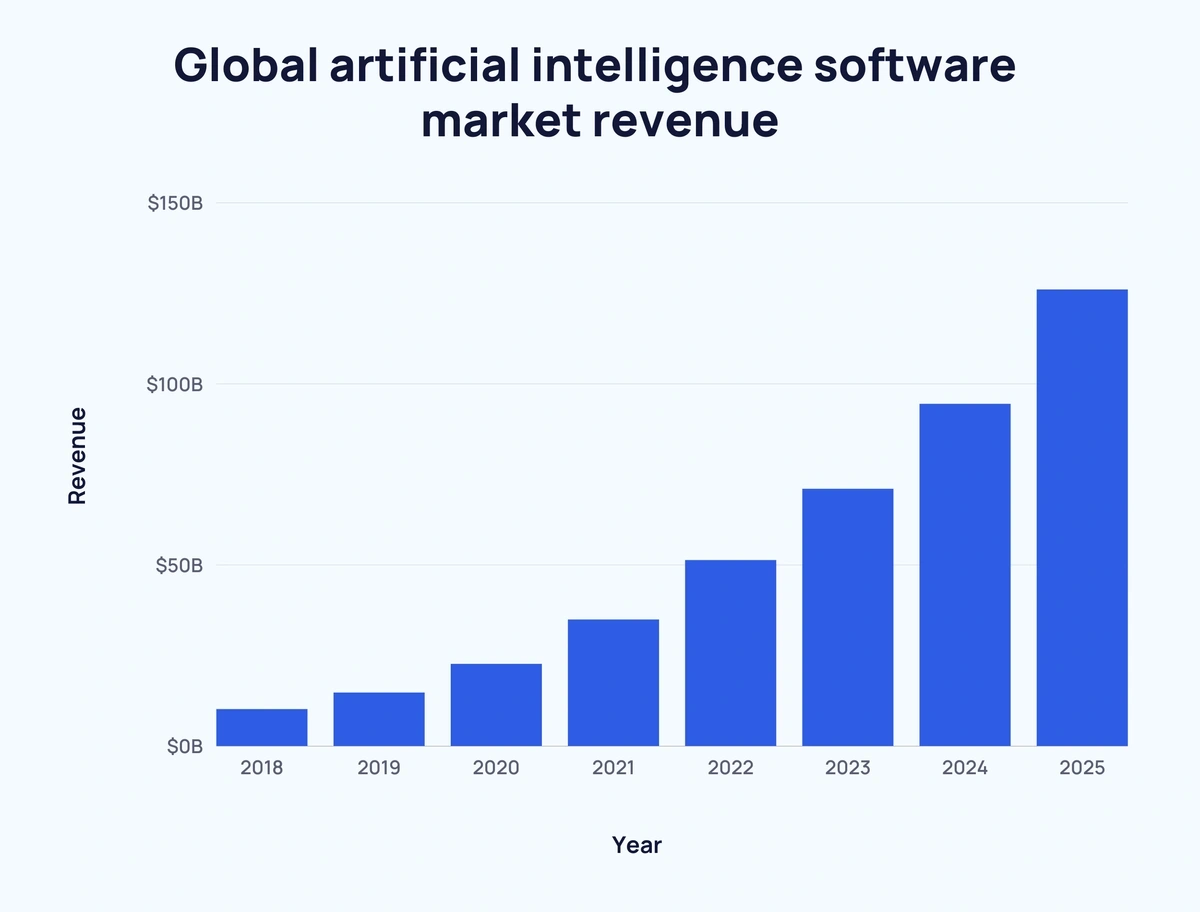
The AI software market’s global annual revenue (2018 to 2025):
Revenue
$10.1 billion
$14.69 billion
$22.59 billion
$34.87 billion
$51.27 billion
$70.94 billion
$94.41 billion
$126 billion
*Projected figures.
In late 2022, ChatGPT broke records as the AI platform reached 1 million users in less than a week.
By early 2023, ChatGPT had accumulated over 100 million monthly users.
One survey found that 87% of global organizations believe that AI technologies will give them a competitive edge.
This equates to an increase of 12% from the previous year.
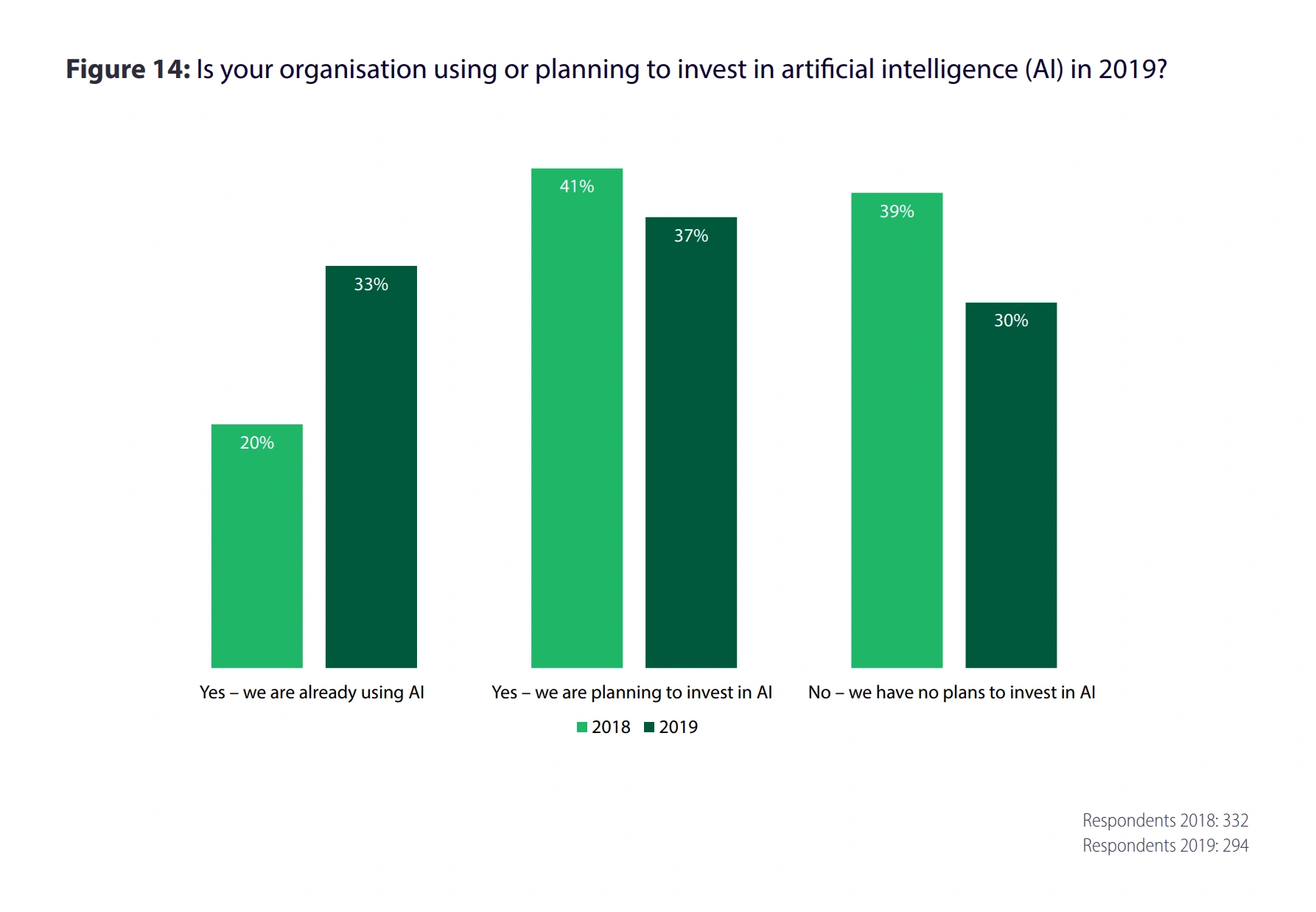
In 2015 just 10% of organizations used or planned to implement AI in the near future.
By 2019, this figure had surged to 37%.
According to Hostinger Tutorials, 35% of companies use AI services.
AI’s recent rapid growth is unlikely to slow down in the near future.
In fact, global AI adoption by organizations is set to expand at a CAGR of 36.6% between 2024 and 2030.
In 2020, AI services generated approximately $19.4 billion in revenue.
In 2022, the market was estimated to grow to $62.5 billion.
And by 2025, the AI space is forecast to reach $126 billion in annual revenue.
The success of products like the Apple Watch and Fitbits is set to boost the global wearable AI market value.
By 2025, the market is expected to be valued at $180 billion.
Some estimates suggest that AI technology could generate $15.7 trillion in revenue by 2030. Boosting the GDP of local economies by an additional 26%.
The latest available data predicts a lucrative near future for the AI market.
Between 2021 and 2022, the AI market was projected to grow by 47%.
And this upward trajectory was forecast to continue year-over-year – increasing by at least 26% each year until 2025.
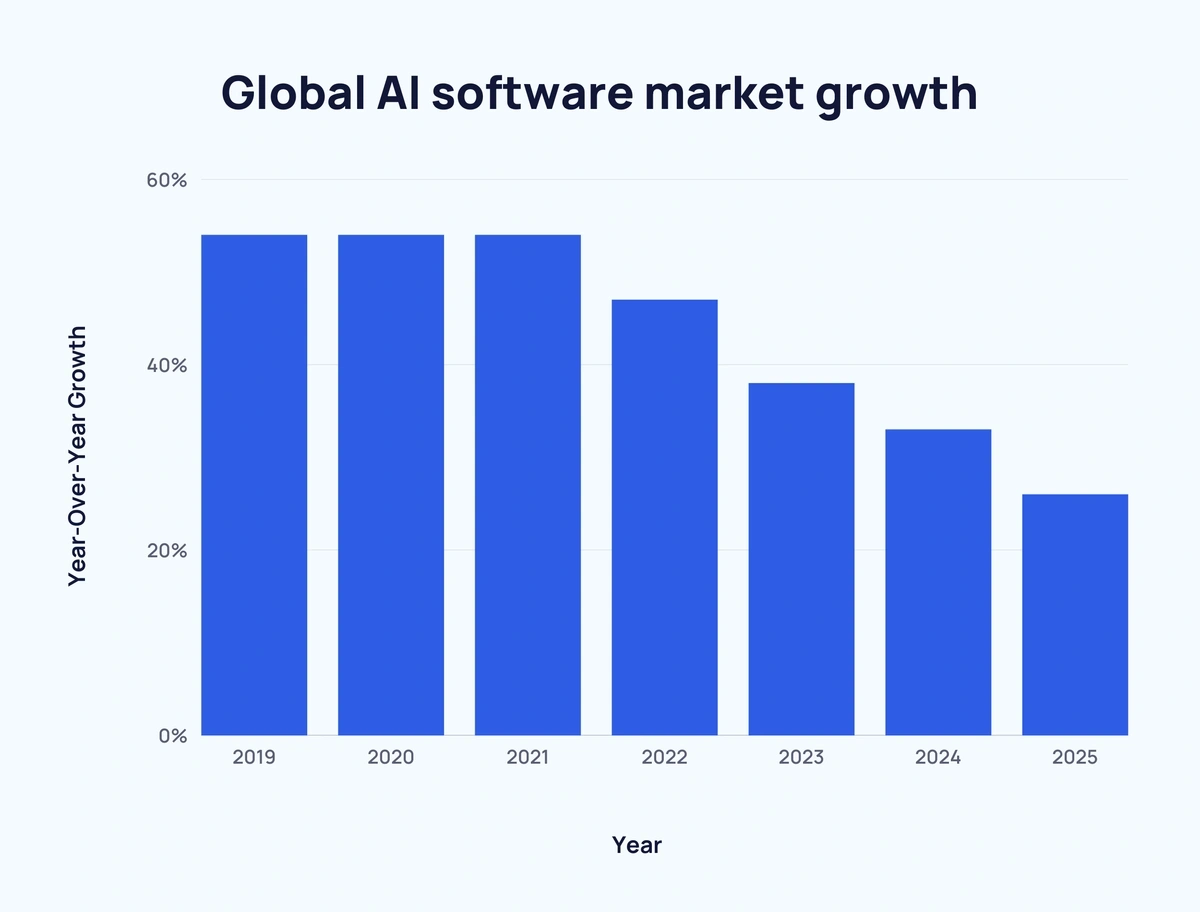
Year-Over-Year Growth
54%
54%
54%
47%
38%
33%
26%
The latest data shows that global AI chip revenue is set to reach $83.25 billion by 2027.
If the projections about growth in the AI space come to fruition, further manpower will be required.
By 2025, approximately 97 million people will be necessary to fill the work demands of the surging industry.
As dependency on human intelligence decreases, this figure is set to rise further.
By 2026, the US AI space will be worth a reported $299.64 billion. Between 2021-2028 That’s a predicted CAGR of 40.2% between 2021 and 2028.
The world’s second-largest economy, China, will have an AI industry worth around $40.6 billion by 2026. Growing at a CAGR of 39.1%.
By 2030, China will account for 26.1% of the global AI market share.
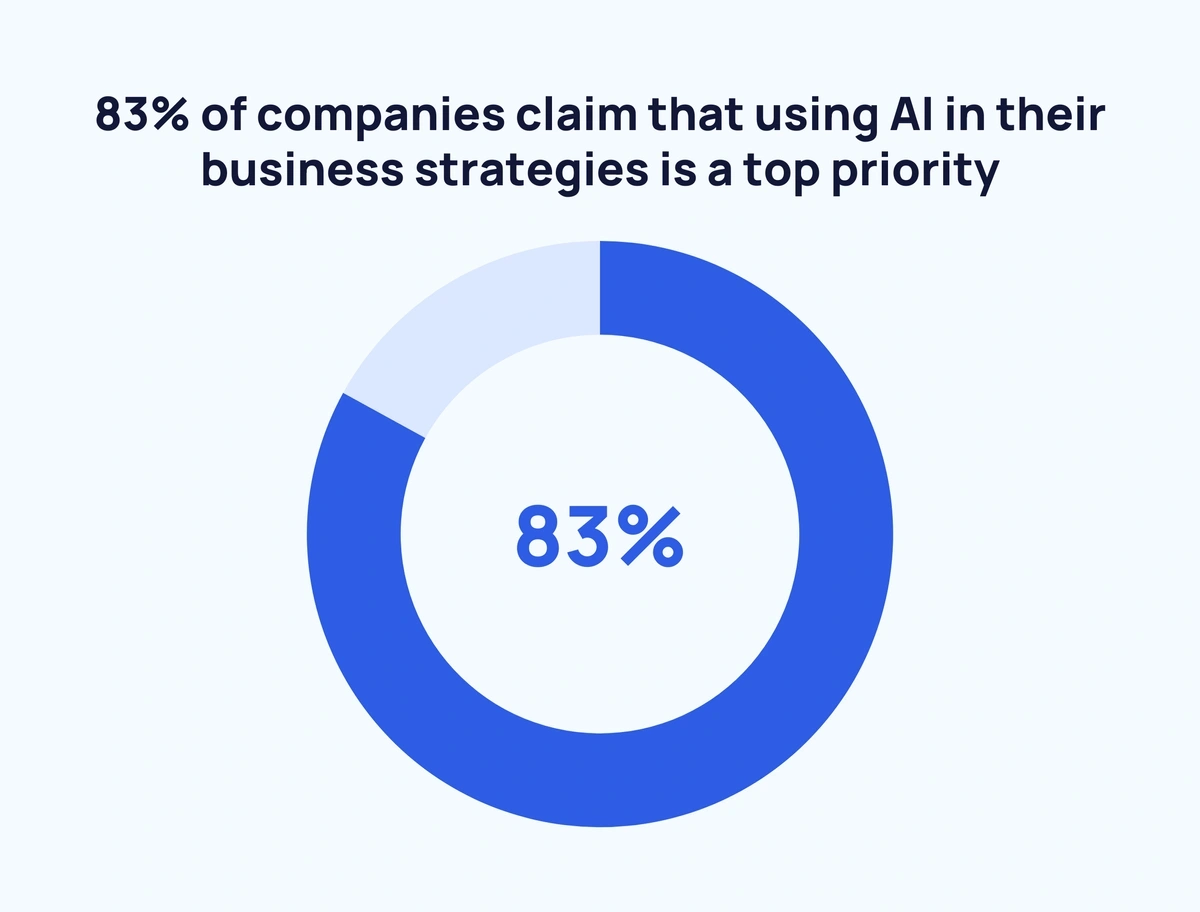
A whopping 83% of companies claim that using AI in their business strategies is a top priority.
Automated emails and chatbots are two of the most common uses of AI in everyday business communications.
Here’s a look at current company usage of AI:
The vast majority of surveyed retail executives believe their company will utilize AI automation within the next three years.
86% of CEOs agree that AI and business go hand-in-hand since AI is mainstream technology in their offices.
Data suggests that AI has the potential to boost employee productivity by approximately 40% by 2035.
Many consumers will likely agree that Netflix’s use of AI is one of their biggest selling points. The streaming platform utilizes AI to personalize recommendations and tailor them to viewers’ interests.
Tech companies that invest in AI often significantly increase their revenue as algorithms can keep the consumer constantly returning for more.
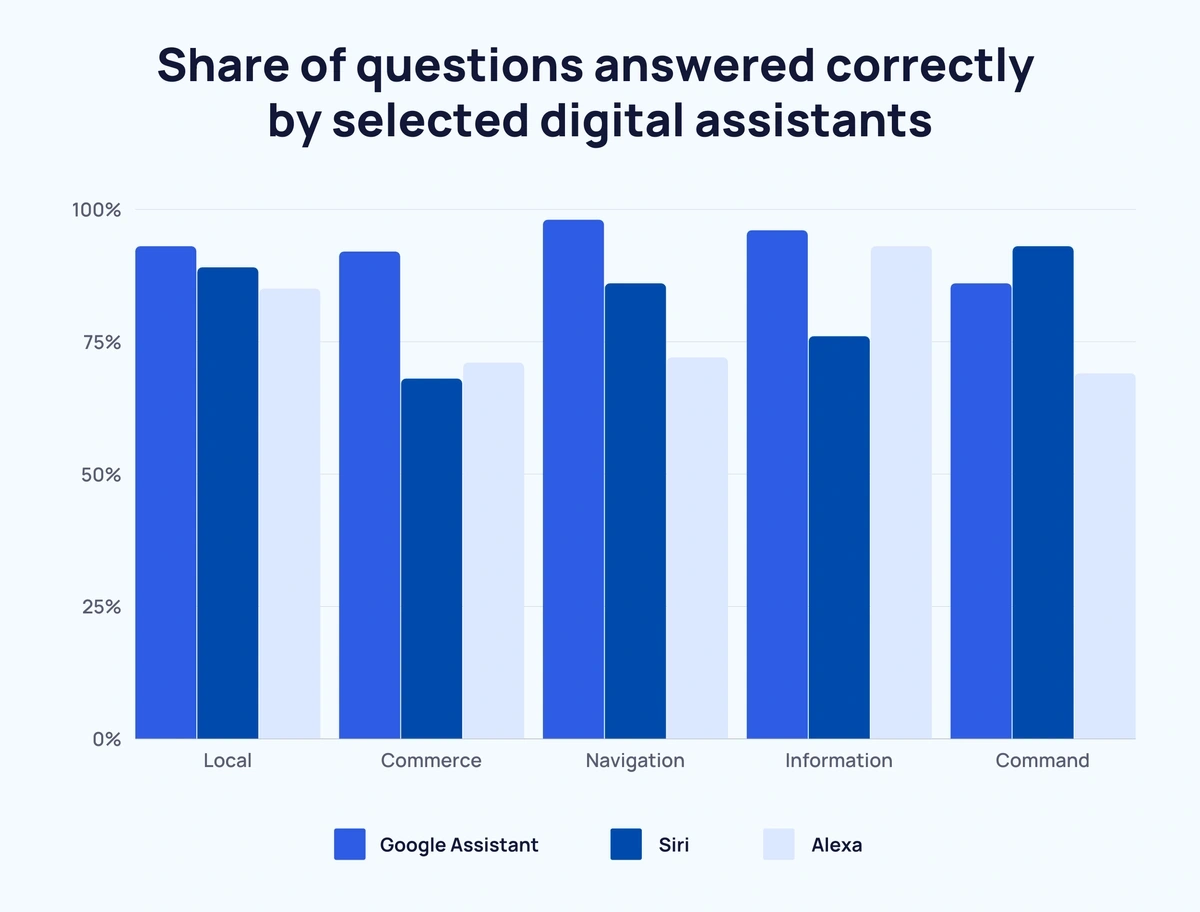
Google Assistant outranks its voice assistant competitors, such as Apple Inc.’s Siri and Microsoft’s Cortana, with an accuracy record of 98% in navigation.
93%
89%
85%
92%
68%
71%
98%
86%
72%
96%
76%
93%
86%
93%
69%
52% of telecommunications organizations utilize chatbots to increase their overall productivity.
One key AI application in business is providing personalized product recommendations via consumer behavior forecasting and targeted advertising.
Pop-up marketing ads and chatbots are each examples of AI operations.
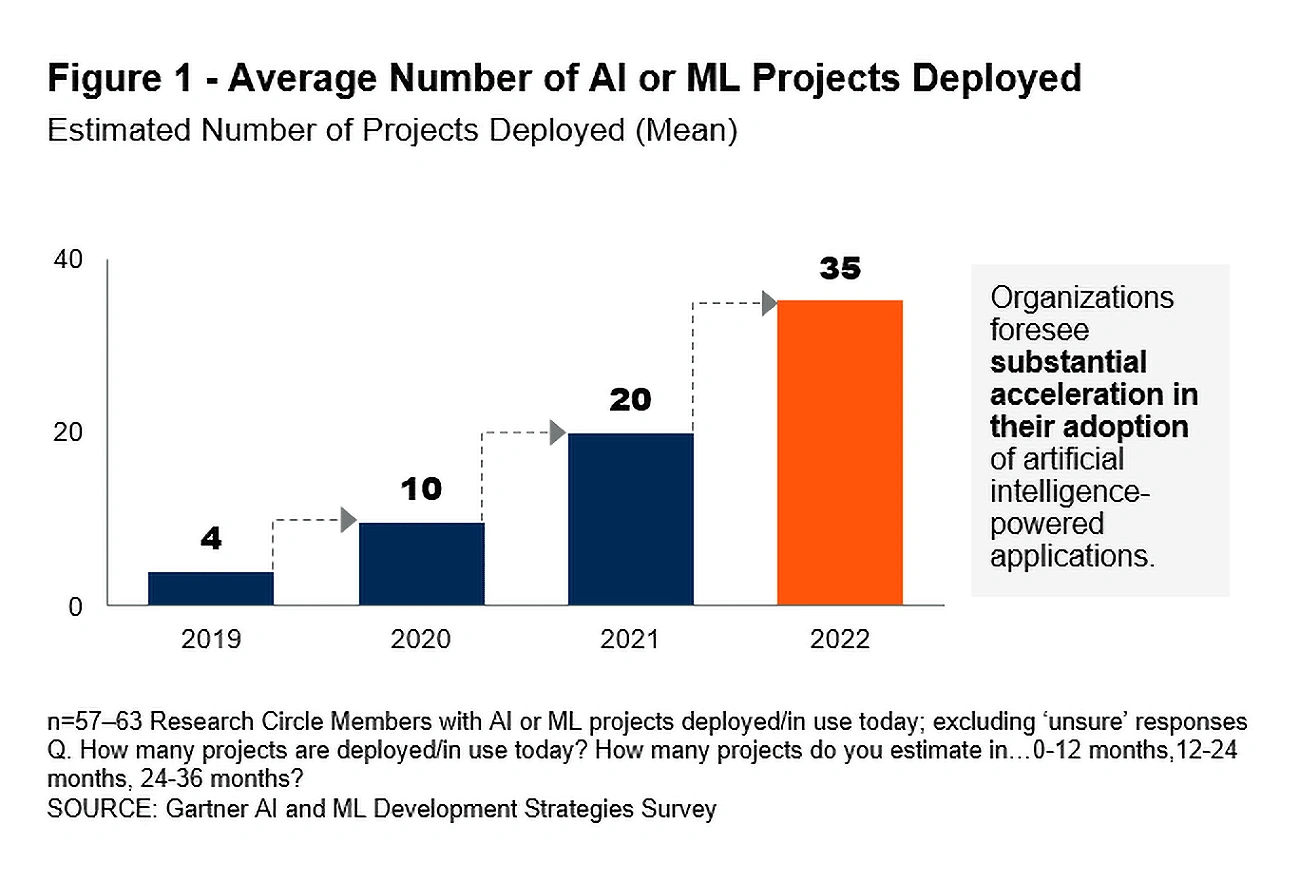
Automation usually translates to less waiting time for customers.
To maintain the accuracy of their data, 48% of businesses use machine learning (ML), data analysis, and AI tools.
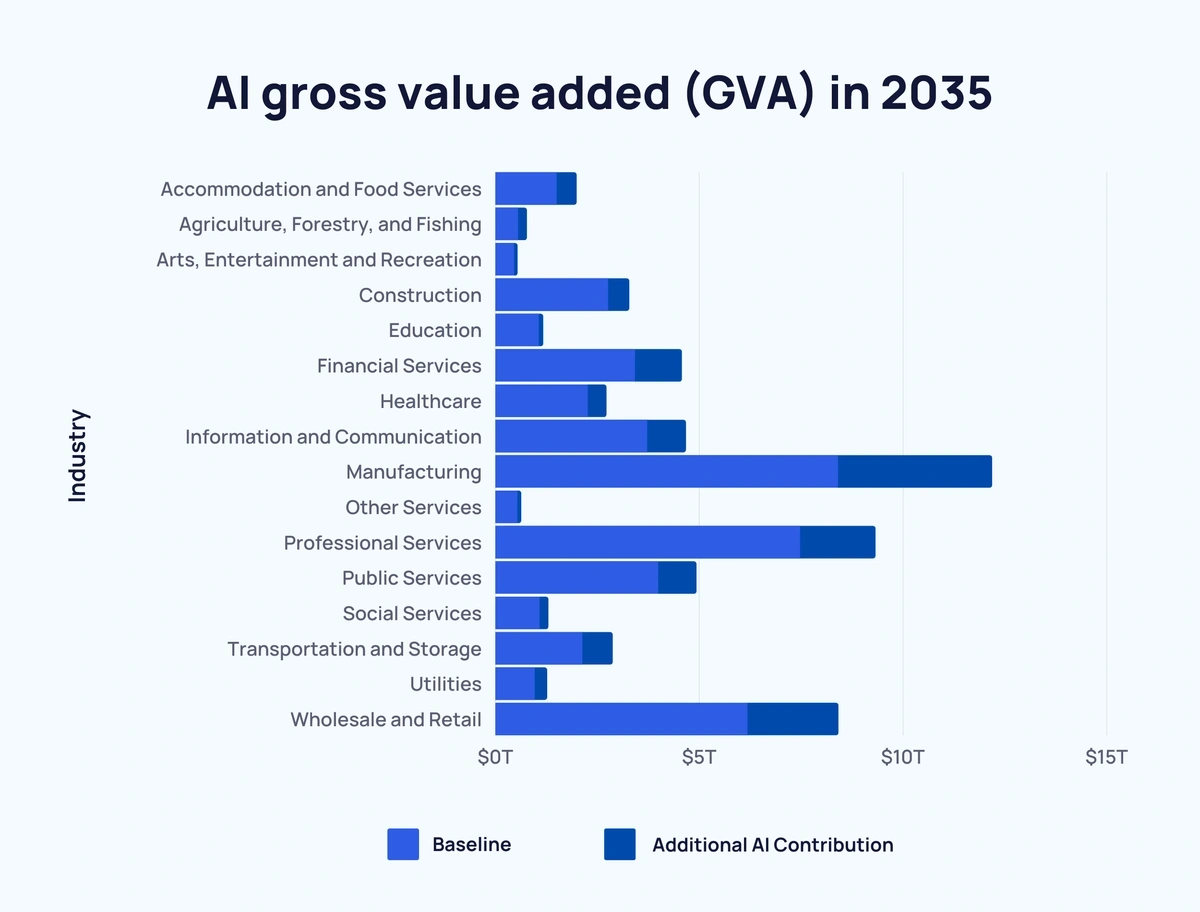
The AI industry has a foothold in various business functions, from cloud computing for datasets to streamlining company decision-making.
Industry verticals utilizing AI technology include tech-related sales, insurance, banking, telecom, healthcare, manufacturing, retail, and marketing to name a few.
$1.5 trillion
$489 billion
$554 billion
$215 billion
$453 billion
$87 billion
$2.76 trillion
$520 billion
$1.06 trillion
$109 billion
$3.42 trillion
$1.15 trillion
$2.26 trillion
$461 billion
$3.72 trillion
$951 billion
$8.4 trillion
$3.78 trillion
$535 billion
$95 billion
$7.47 trillion
$1.85 trillion
$3.99 trillion
$939 billion
$1.08 trillion
$216 billion
$2.13 trillion
$744 billion
$962 billion
$304 billion
$6.18 trillion
$2.23 trillion
The self-driving car market is proving to be more than a novelty niche by grossing $173 billion in global revenue.
The prevalence of chatbots may be increasing but they still have a long way to go.
Just under 1 in 10 people (7%) trust chatbots when making a claim.
A stark difference from the 49% that trust human advisors.
By 2035, AI technology will add $1 billion to the banking industry.

As of 2022, the telecommunications AI market is worth approximately $2.5 billion.
Growing at a CAGR of 46.8% during the forecast period of 2016-2022.
38% of medical providers use computer systems as their diagnosis assistants.
Manufacturing businesses that utilize AI are performing 12% better than businesses that continue to use traditional methods only.
In the next few years, the retail industry will be able to relinquish much of its communication to AI.
In fact, over 95% of online and telephone communications will utilize AI technology.
80% of marketers believe that AI technology is not a trend, but a revolution that will revitalize the way in which all industries approach their work.
AI marketing companies, customer service roles, and sales departments rely on process automation to increase their market revenue share.
Artificial intelligence is a solution for overworked customer-facing roles.
AI algorithms reveal data on which products generate the highest profit margins and offer valuable insight into a client’s purchasing habits.
Recent data shows that using AI for sales:
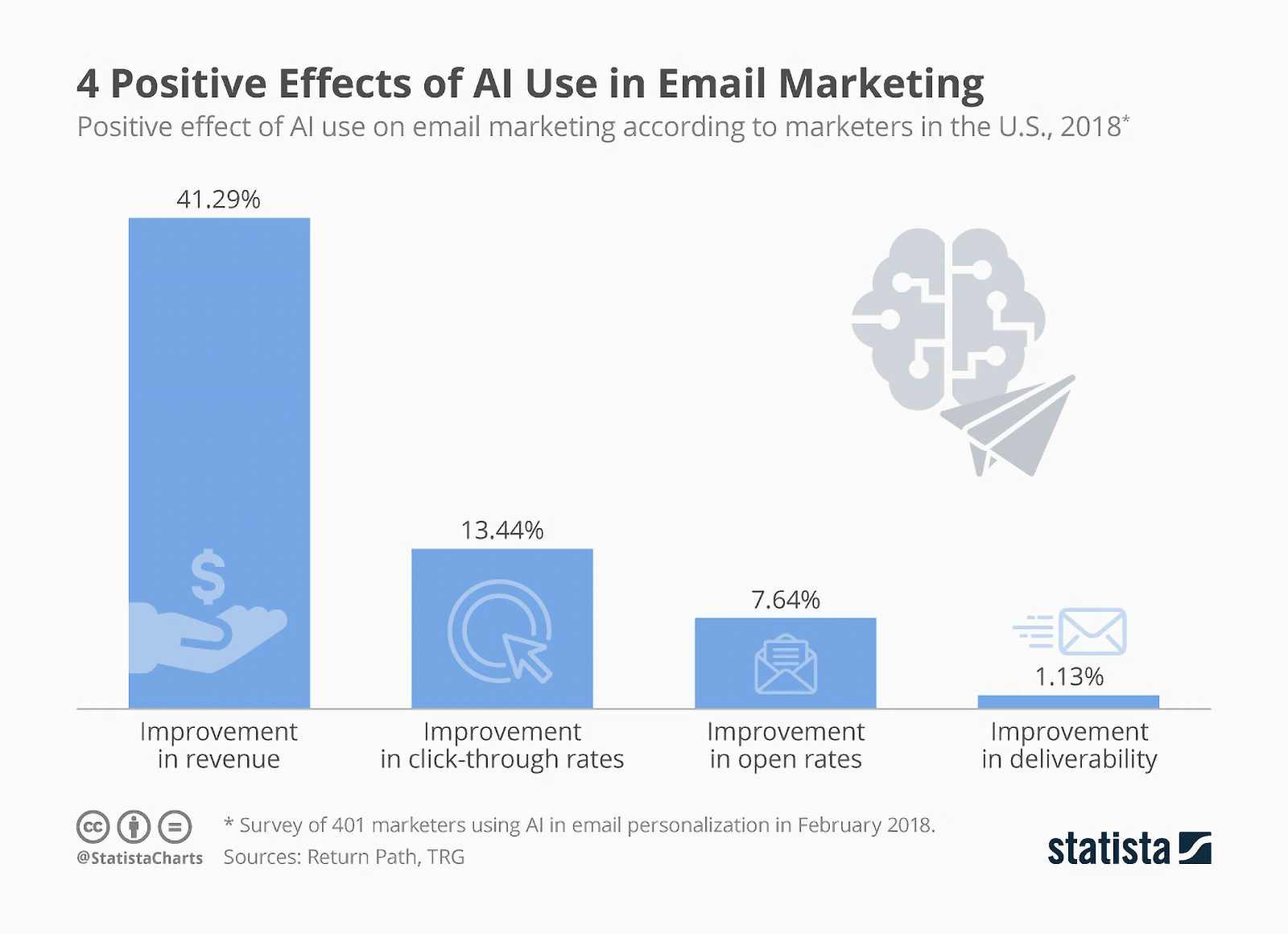
In total 41.29% of marketers agree that using AI for email marketing generates higher market revenue.
Many people worry that AI will continue to take jobs from human workers resulting in a job crisis.
And some are even asking whether they should start looking for a new career solution before automation makes their current role obsolete.
Below is data on employment shares and the proportion of jobs at high risk of automation by the early 2030s for all UK industry sectors:
Fears of being made redundant might be justified for workers in the transportation and storage (56.4%), manufacturing (46.4%), and wholesale & retail (44%) industries in the UK.
Despite this, new jobs are likely to arise. The AI market will create 9% of new jobs in the US for a net loss of 7%.
The uses for AI stretch far beyond cataloging the content of your online shopping cart.
Artificial intelligence systems can function as digital personal assistants, turn the lights on in a smart home, and even protect against infectious diseases like COVID-19.
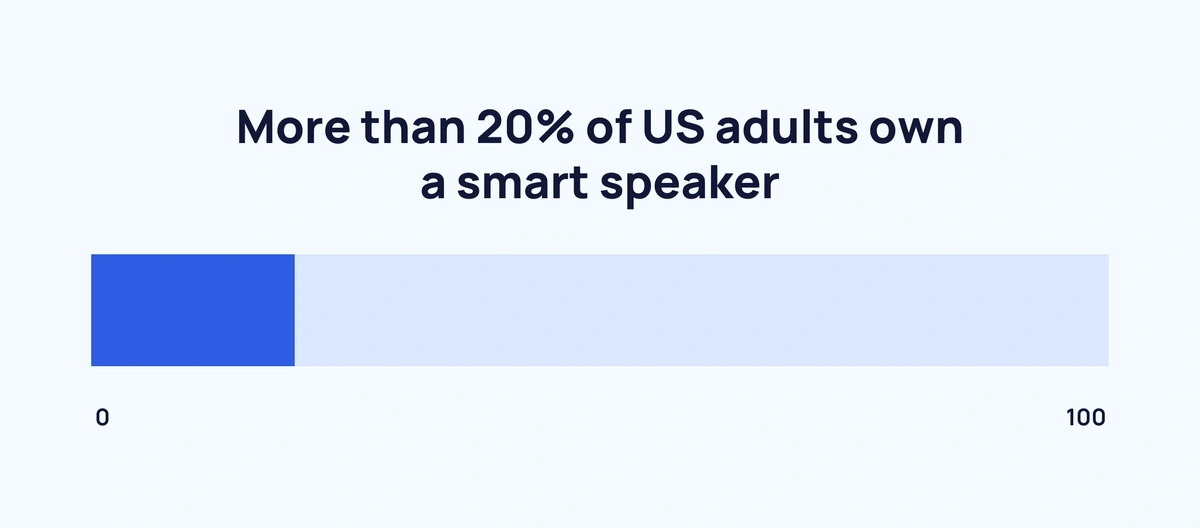
Popular smart speakers include Apple’s HomePod and the Amazon Echo.
These use speech recognition technology to provide weather forecasts, play music, or make emergency phone calls.
Before COVID-19 became an all-too-common term in the healthcare sector, AI reports included an outbreak of an unknown type of pneumonia.
Wearable tech can even aid the healthcare sector’s mission to create a healthier world.
Chatbots may still need improvements in natural language processing before consumers are on board.
But voice assistants are a prime example of AI merging seamlessly with everyday life.
Here is the number of digital voice assistants in use worldwide from 2019 to 2024:
*Projected figures.
This year, voice assistants equipped with natural language processing technology may outnumber the human race at 8.4 billion devices.
Over 110 million virtual assistant users reside in the US.
And as of early 2020, voice assistants were a source of information for 51% of all US residents.
Natural language processing (NLP) helps computers translate human language into information they understand by manipulating data.
Companies are striving to bridge the gap between human language and machine intelligence.
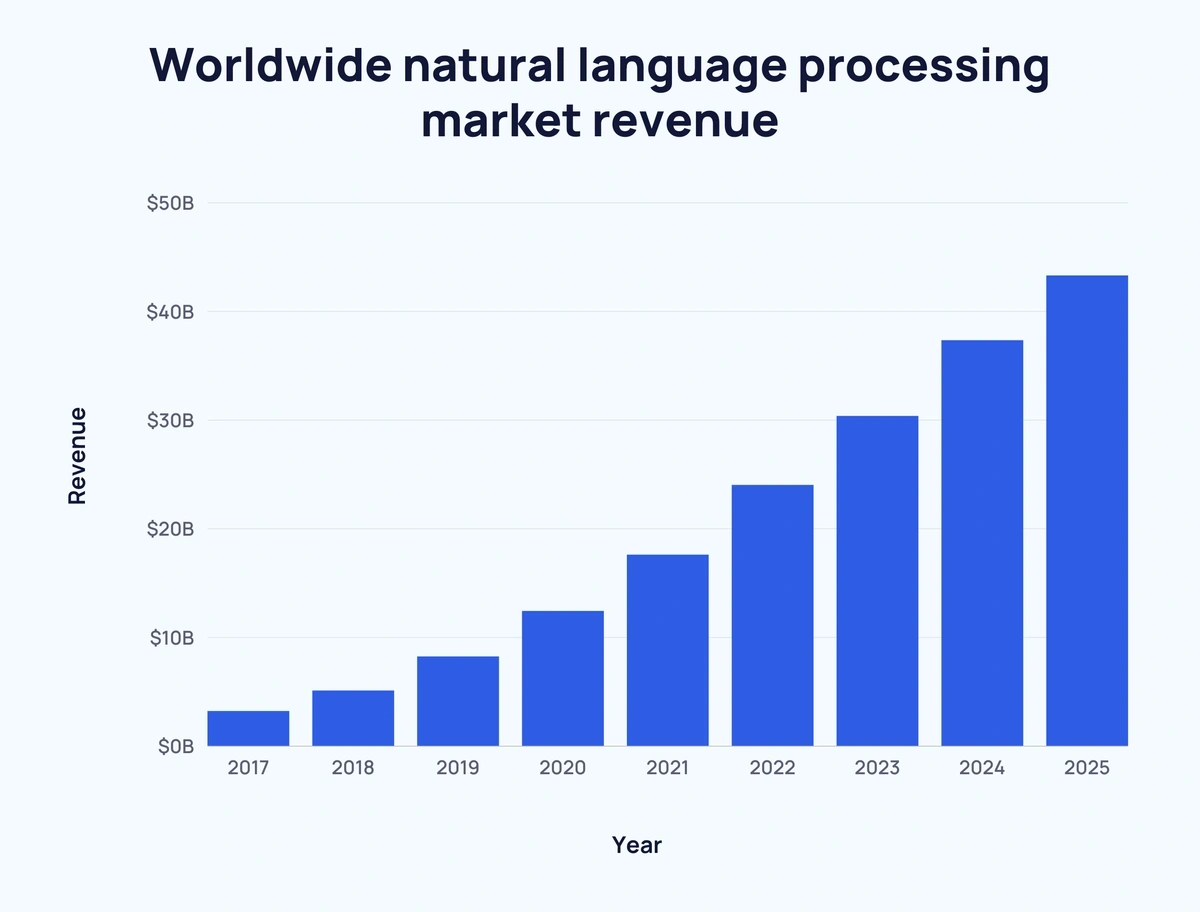
Here’s a look at global revenue from the NLP market from 2017 to 2025:
Revenue
$3.18 billion
$5.07 billion
$8.21 billion
$12.4 billion
$17.58 billion
$24 billion
$30.35 billion
$37.33 billion
$43.29 billion
*Projected figures
During the forecast period of 2017-2025, the NLP market is set to grow by around 14x.
The healthcare sector should expect a higher usage of cloud resources, such as ML, natural language processing, and deep learning.
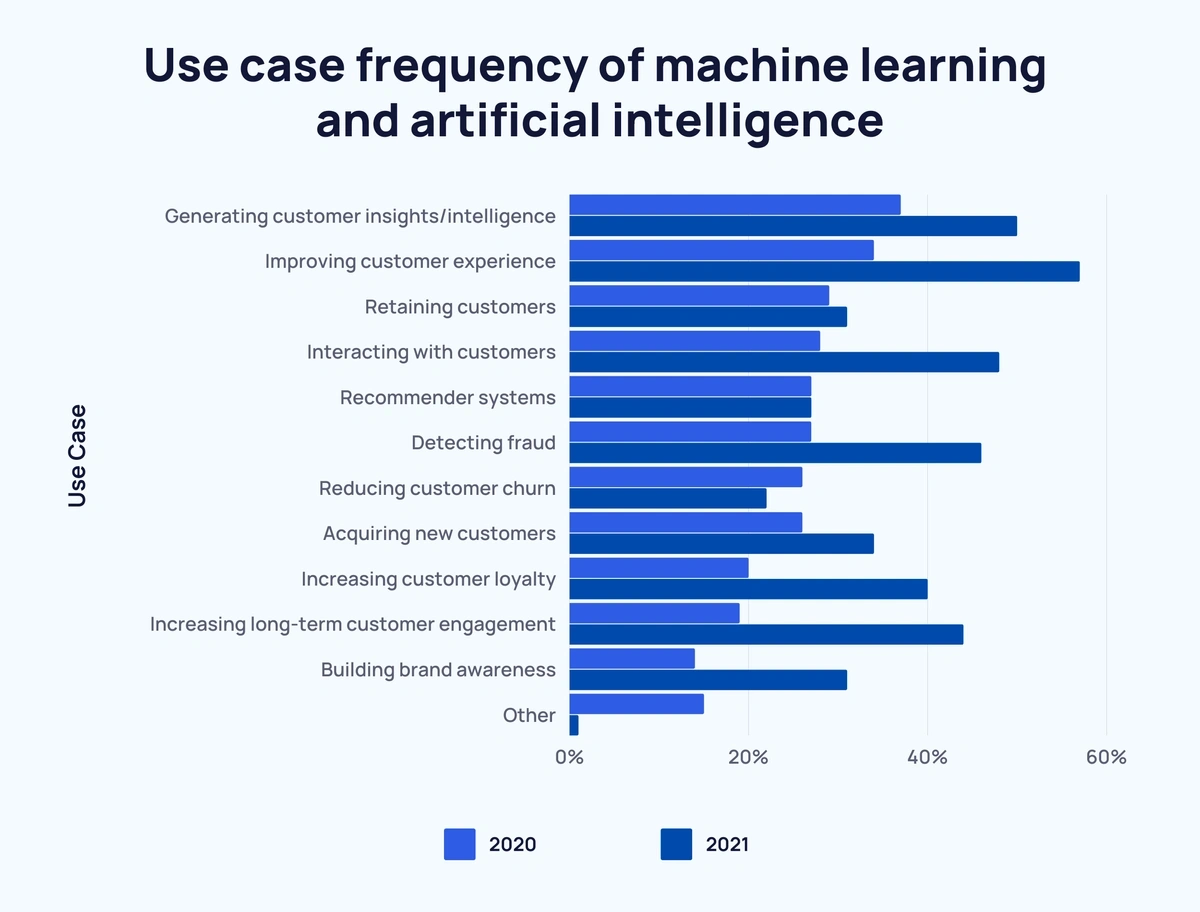
Algorithms and ML enable computers to predict patterns, evaluate accuracy, and continually optimize the process.
A computer’s speech recognition capability and a smartphone’s ability to geotag video content before sharing are examples of ML.
2020
2021
Change
37%
50%
34%
57%
29%
31%
28%
48%
27%
27%
27%
46%
26%
22%
26%
34%
20%
40%
19%
44%
14%
31%
15%
1%
It is also shown to be more effective than human pathologists at detecting metastatic breast cancer.
This makes the system more accurate than human lip readers.
Google uses global AI technologies to process 6.9 billion daily search queries (techjury)
AI technology makes searching and organizing big data sets possible.
When conventional methods of storing and collecting big data fail, AI technology takes the reins and processes the billions of search queries search engines receive daily.
WhatsApp is the most popular messaging app in the world. AI helps process more than 100 billion messages every day.
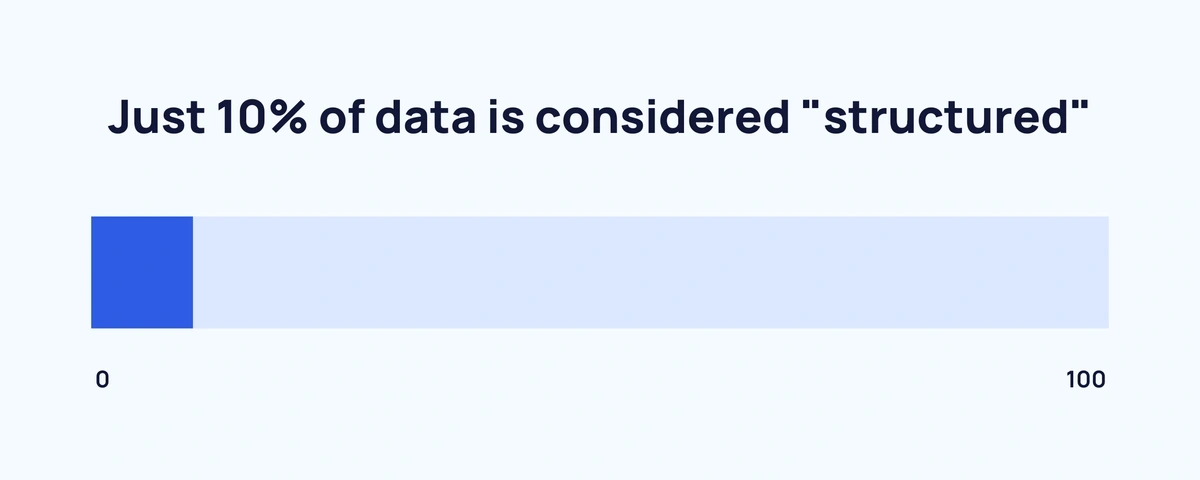
90% of data is unstructured, meaning that without technology to process the big data, companies are unable to focus on important data points.
Therefore, companies could be missing out on opportunities to increase their revenue.
AI progress comes with its fair share of ethical, business, and practical concerns.
These include job loss and the ethical implications of computer integration with conscious thought.
Elon Musk is best known for electric cars and rocket ships. But he’s also an investor in one of the world’s fastest-growing AI startups: OpenAI. This makes it noteworthy that Musk wonders er whether AI will be sentient in the next 2-5 years.
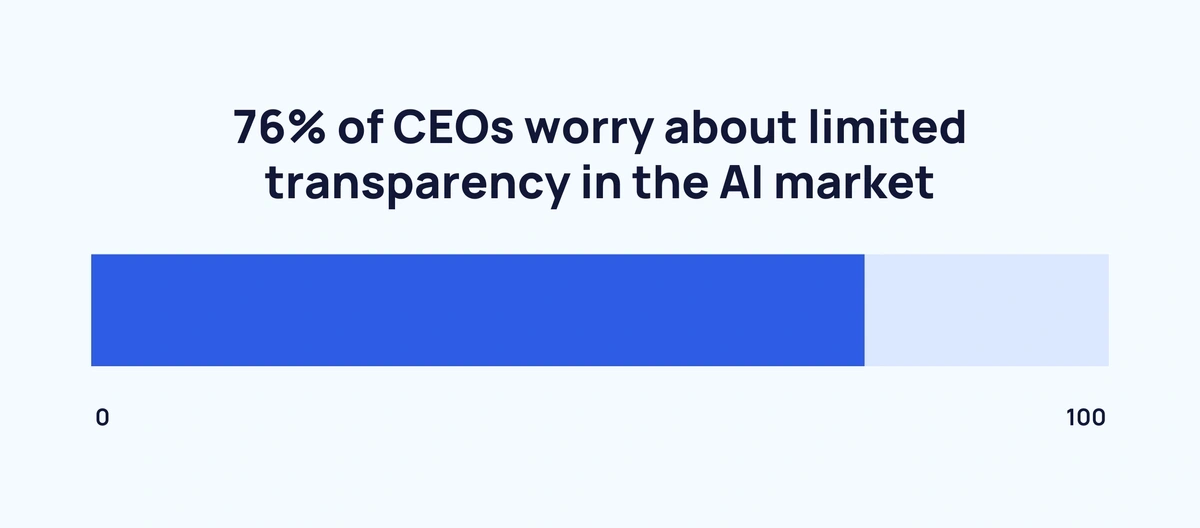
A 2017 survey found that 76% of CEOs worry about the lack of transparency and the potential of skewed biases in the global AI market.
However, 40% of executives agree that advanced AI technologies and the experts who run them are currently too expensive to implement.
The AI market clearly has a promising and profitable future.
While concerns over job loss exist, there is data to indicate that the technology will create more startups and jobs than it destroys.
One way or another, AI is most definitely part of the present. And the future.
For more related content, check out Top AI and Machine Learning Trends and Trending Machine Learning Startups.
548 Market St. Suite 95149
San Francisco, California
This article was autogenerated from a news feed from CDO TIMES selected high quality news and research sources. There was no editorial review conducted beyond that by CDO TIMES staff. Need help with any of the topics in our articles? Schedule your free CDO TIMES Tech Navigator call today to stay ahead of the curve and gain insider advantages to propel your business!
From ChatGPT to autonomous vehicles, AI is one of the most exciting (and controversial) technology trends happening in the 21st century.
But how big is the AI space? And how quickly is it growing?
In this article, we’ll take a closer look at key AI statistics, along with growth projections for the future.
Contents
As of the latest available data from 2023, the global AI market is worth $196.63 billion. That’s an increase of around $60 billion since 2022.
This is primarily thanks to increasing practical use cases of AI technology, from content creation to self-driving cars.
While the current AI market is sizeable, it’s set to grow by over 13x over the next decade or so.
During this forecast period, the AI market is predicted to increase by a CAGR of 36.6%.
The AI software market’s global annual revenue (2018 to 2025):
Revenue
$10.1 billion
$14.69 billion
$22.59 billion
$34.87 billion
$51.27 billion
$70.94 billion
$94.41 billion
$126 billion
*Projected figures.
In late 2022, ChatGPT broke records as the AI platform reached 1 million users in less than a week.
By early 2023, ChatGPT had accumulated over 100 million monthly users.
One survey found that 87% of global organizations believe that AI technologies will give them a competitive edge.
This equates to an increase of 12% from the previous year.
In 2015 just 10% of organizations used or planned to implement AI in the near future.
By 2019, this figure had surged to 37%.
According to Hostinger Tutorials, 35% of companies use AI services.
AI’s recent rapid growth is unlikely to slow down in the near future.
In fact, global AI adoption by organizations is set to expand at a CAGR of 36.6% between 2024 and 2030.
In 2020, AI services generated approximately $19.4 billion in revenue.
In 2022, the market was estimated to grow to $62.5 billion.
And by 2025, the AI space is forecast to reach $126 billion in annual revenue.
The success of products like the Apple Watch and Fitbits is set to boost the global wearable AI market value.
By 2025, the market is expected to be valued at $180 billion.
Some estimates suggest that AI technology could generate $15.7 trillion in revenue by 2030. Boosting the GDP of local economies by an additional 26%.
The latest available data predicts a lucrative near future for the AI market.
Between 2021 and 2022, the AI market was projected to grow by 47%.
And this upward trajectory was forecast to continue year-over-year – increasing by at least 26% each year until 2025.
Year-Over-Year Growth
54%
54%
54%
47%
38%
33%
26%
The latest data shows that global AI chip revenue is set to reach $83.25 billion by 2027.
If the projections about growth in the AI space come to fruition, further manpower will be required.
By 2025, approximately 97 million people will be necessary to fill the work demands of the surging industry.
As dependency on human intelligence decreases, this figure is set to rise further.
By 2026, the US AI space will be worth a reported $299.64 billion. Between 2021-2028 That’s a predicted CAGR of 40.2% between 2021 and 2028.
The world’s second-largest economy, China, will have an AI industry worth around $40.6 billion by 2026. Growing at a CAGR of 39.1%.
By 2030, China will account for 26.1% of the global AI market share.
A whopping 83% of companies claim that using AI in their business strategies is a top priority.
Automated emails and chatbots are two of the most common uses of AI in everyday business communications.
Here’s a look at current company usage of AI:
The vast majority of surveyed retail executives believe their company will utilize AI automation within the next three years.
86% of CEOs agree that AI and business go hand-in-hand since AI is mainstream technology in their offices.
Data suggests that AI has the potential to boost employee productivity by approximately 40% by 2035.
Many consumers will likely agree that Netflix’s use of AI is one of their biggest selling points. The streaming platform utilizes AI to personalize recommendations and tailor them to viewers’ interests.
Tech companies that invest in AI often significantly increase their revenue as algorithms can keep the consumer constantly returning for more.
Google Assistant outranks its voice assistant competitors, such as Apple Inc.’s Siri and Microsoft’s Cortana, with an accuracy record of 98% in navigation.
93%
89%
85%
92%
68%
71%
98%
86%
72%
96%
76%
93%
86%
93%
69%
52% of telecommunications organizations utilize chatbots to increase their overall productivity.
One key AI application in business is providing personalized product recommendations via consumer behavior forecasting and targeted advertising.
Pop-up marketing ads and chatbots are each examples of AI operations.
Automation usually translates to less waiting time for customers.
To maintain the accuracy of their data, 48% of businesses use machine learning (ML), data analysis, and AI tools.
The AI industry has a foothold in various business functions, from cloud computing for datasets to streamlining company decision-making.
Industry verticals utilizing AI technology include tech-related sales, insurance, banking, telecom, healthcare, manufacturing, retail, and marketing to name a few.
$1.5 trillion
$489 billion
$554 billion
$215 billion
$453 billion
$87 billion
$2.76 trillion
$520 billion
$1.06 trillion
$109 billion
$3.42 trillion
$1.15 trillion
$2.26 trillion
$461 billion
$3.72 trillion
$951 billion
$8.4 trillion
$3.78 trillion
$535 billion
$95 billion
$7.47 trillion
$1.85 trillion
$3.99 trillion
$939 billion
$1.08 trillion
$216 billion
$2.13 trillion
$744 billion
$962 billion
$304 billion
$6.18 trillion
$2.23 trillion
The self-driving car market is proving to be more than a novelty niche by grossing $173 billion in global revenue.
The prevalence of chatbots may be increasing but they still have a long way to go.
Just under 1 in 10 people (7%) trust chatbots when making a claim.
A stark difference from the 49% that trust human advisors.
By 2035, AI technology will add $1 billion to the banking industry.
As of 2022, the telecommunications AI market is worth approximately $2.5 billion.
Growing at a CAGR of 46.8% during the forecast period of 2016-2022.
38% of medical providers use computer systems as their diagnosis assistants.
Manufacturing businesses that utilize AI are performing 12% better than businesses that continue to use traditional methods only.
In the next few years, the retail industry will be able to relinquish much of its communication to AI.
In fact, over 95% of online and telephone communications will utilize AI technology.
80% of marketers believe that AI technology is not a trend, but a revolution that will revitalize the way in which all industries approach their work.
AI marketing companies, customer service roles, and sales departments rely on process automation to increase their market revenue share.
Artificial intelligence is a solution for overworked customer-facing roles.
AI algorithms reveal data on which products generate the highest profit margins and offer valuable insight into a client’s purchasing habits.
Recent data shows that using AI for sales:
In total 41.29% of marketers agree that using AI for email marketing generates higher market revenue.
Many people worry that AI will continue to take jobs from human workers resulting in a job crisis.
And some are even asking whether they should start looking for a new career solution before automation makes their current role obsolete.
Below is data on employment shares and the proportion of jobs at high risk of automation by the early 2030s for all UK industry sectors:
Fears of being made redundant might be justified for workers in the transportation and storage (56.4%), manufacturing (46.4%), and wholesale & retail (44%) industries in the UK.
Despite this, new jobs are likely to arise. The AI market will create 9% of new jobs in the US for a net loss of 7%.
The uses for AI stretch far beyond cataloging the content of your online shopping cart.
Artificial intelligence systems can function as digital personal assistants, turn the lights on in a smart home, and even protect against infectious diseases like COVID-19.
Popular smart speakers include Apple’s HomePod and the Amazon Echo.
These use speech recognition technology to provide weather forecasts, play music, or make emergency phone calls.
Before COVID-19 became an all-too-common term in the healthcare sector, AI reports included an outbreak of an unknown type of pneumonia.
Wearable tech can even aid the healthcare sector’s mission to create a healthier world.
Chatbots may still need improvements in natural language processing before consumers are on board.
But voice assistants are a prime example of AI merging seamlessly with everyday life.
Here is the number of digital voice assistants in use worldwide from 2019 to 2024:
*Projected figures.
This year, voice assistants equipped with natural language processing technology may outnumber the human race at 8.4 billion devices.
Over 110 million virtual assistant users reside in the US.
And as of early 2020, voice assistants were a source of information for 51% of all US residents.
Natural language processing (NLP) helps computers translate human language into information they understand by manipulating data.
Companies are striving to bridge the gap between human language and machine intelligence.
Here’s a look at global revenue from the NLP market from 2017 to 2025:
Revenue
$3.18 billion
$5.07 billion
$8.21 billion
$12.4 billion
$17.58 billion
$24 billion
$30.35 billion
$37.33 billion
$43.29 billion
*Projected figures
During the forecast period of 2017-2025, the NLP market is set to grow by around 14x.
The healthcare sector should expect a higher usage of cloud resources, such as ML, natural language processing, and deep learning.
Algorithms and ML enable computers to predict patterns, evaluate accuracy, and continually optimize the process.
A computer’s speech recognition capability and a smartphone’s ability to geotag video content before sharing are examples of ML.
2020
2021
Change
37%
50%
34%
57%
29%
31%
28%
48%
27%
27%
27%
46%
26%
22%
26%
34%
20%
40%
19%
44%
14%
31%
15%
1%
It is also shown to be more effective than human pathologists at detecting metastatic breast cancer.
This makes the system more accurate than human lip readers.
Google uses global AI technologies to process 6.9 billion daily search queries (techjury)
AI technology makes searching and organizing big data sets possible.
When conventional methods of storing and collecting big data fail, AI technology takes the reins and processes the billions of search queries search engines receive daily.
WhatsApp is the most popular messaging app in the world. AI helps process more than 100 billion messages every day.
90% of data is unstructured, meaning that without technology to process the big data, companies are unable to focus on important data points.
Therefore, companies could be missing out on opportunities to increase their revenue.
AI progress comes with its fair share of ethical, business, and practical concerns.
These include job loss and the ethical implications of computer integration with conscious thought.
Elon Musk is best known for electric cars and rocket ships. But he’s also an investor in one of the world’s fastest-growing AI startups: OpenAI. This makes it noteworthy that Musk wonders er whether AI will be sentient in the next 2-5 years.
A 2017 survey found that 76% of CEOs worry about the lack of transparency and the potential of skewed biases in the global AI market.
However, 40% of executives agree that advanced AI technologies and the experts who run them are currently too expensive to implement.
The AI market clearly has a promising and profitable future.
While concerns over job loss exist, there is data to indicate that the technology will create more startups and jobs than it destroys.
One way or another, AI is most definitely part of the present. And the future.
For more related content, check out Top AI and Machine Learning Trends and Trending Machine Learning Startups.
548 Market St. Suite 95149
San Francisco, California
This article was autogenerated from a news feed from CDO TIMES selected high quality news and research sources. There was no editorial review conducted beyond that by CDO TIMES staff. Need help with any of the topics in our articles? Schedule your free CDO TIMES Tech Navigator call today to stay ahead of the curve and gain insider advantages to propel your business!
